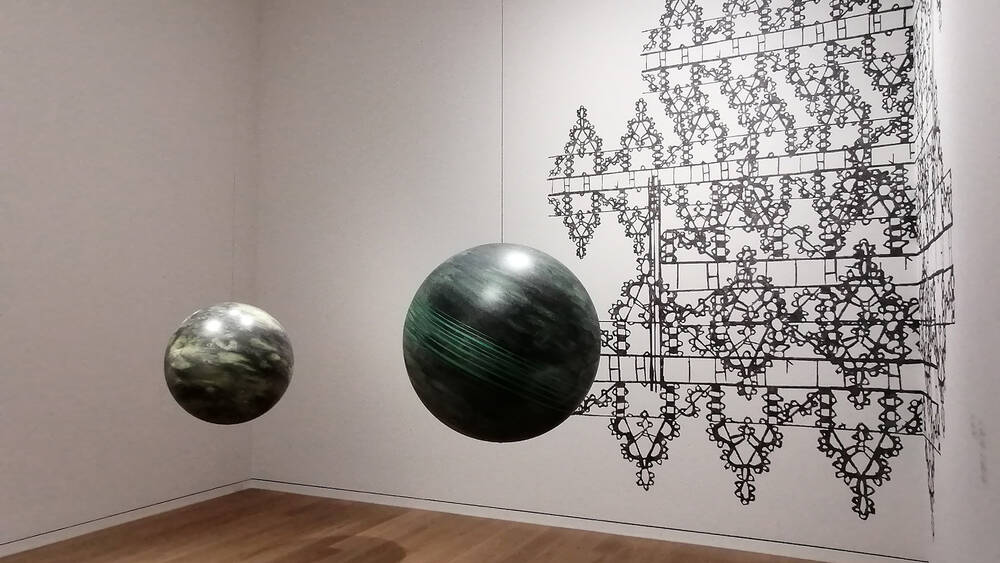
In her wall installations, Katja Davar draws on the pattern books of Isabella Parasole, a 16th-century Italian artist. Parasole’s lace designs were distributed from Italy to many countries across Europe. Trade facilitates the exchange not only of economic interests but also of cultures. In this context, ornaments become a medium of communication.
Lace, which developed as a distinct textile tradition in Europe, spread through trade, colonization and globalization. Meticulously crafted by hand, it was considered a luxury good and, from the 16th century onward, also a symbol of power.
In Davar’s installation, the structures of the lace ornaments—which usually appear delicate and understated—take on a new presence. Similarly, many diverse trade routes—traced on the globes—which span the world like a network, are made visible.

Additional Navigation Points
Search Tours
Use the convenient filters to narrow down tours and find the perfect guide for you.
TitleText
Night mode
Reset Settings
Are you sure to reset the Multimedia Guide system to factory settings?
That's how it works!
Erfolge
Nachtmodus
Es werde Nacht
Guide
Tour durchgehört
Home sweet home
Logo 3x klicken
Merkzettel
Nutze den Merkzettel
QR
Nutze den QR-Code-Scanner
Hacker
Objekt 1337 nicht gefunden
Clear bookmarks?
Are you sure to clear the list and remove all objects?
Switch tour
The chosen object is part of another tour. By proceeding you leave your current tour.
Masked Contents
If you choose one of the first two options, terms from historical work titles and handed-down descriptions that are racist or otherwise discriminatory will be displayed. The SKD dissociate themselves from this use of language and stand for a critical examination of it.