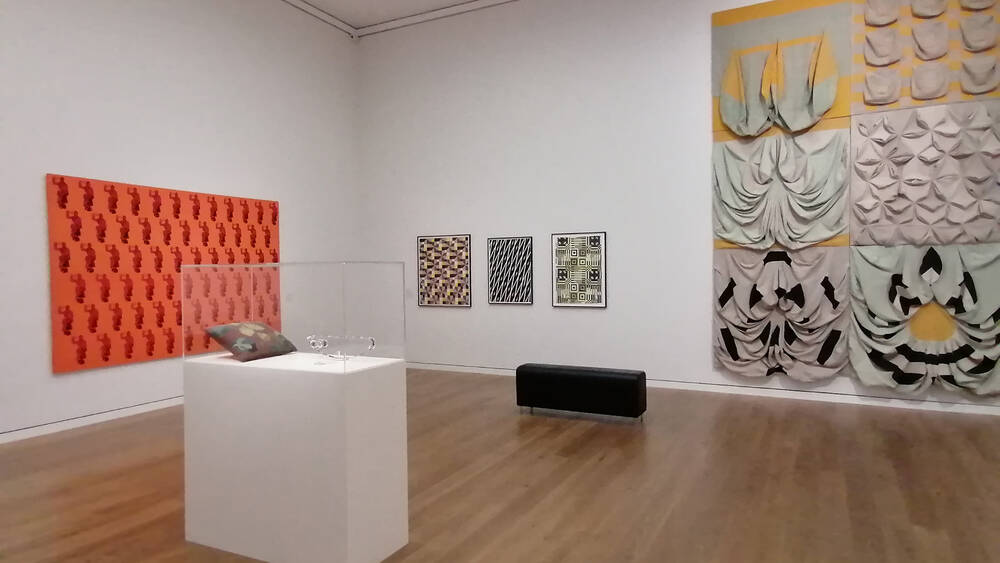
For a long time, female artists were admitted to art schools specialising in the applied arts, particularly textiles. And ornamentation had a firm place within the textile arts. Sophie Taeuber-Arp taught the textile class at the Zurich School of Arts and Crafts for many years. The works on display here illustrate how she created representational motifs from the material's structure itself.
Miriam Schapiro and Silke Radenhausen supported the terms ‘Textiles – Ornament – Art by Women’ positively. They sought to create a form of female art that could hold its own against that of their male colleagues, whilst breaking with convention in terms of material, technique and colour. Miriam Schapiro’s unusual ‘Dormer’ (skylight) form is a response to the enormous formats of the monochromatic paintings of her time. Silke Radenhausen cut and sewed rather than painting on canvas. The result is a three-dimensional object inspired by Owen Jones’s ‘The Grammar of Ornaments’, the most famous book on ornamentation of the 19th century.
Through her works, Rosemarie Trockel questions gender roles, and she uses the ‘harmless’ textile arts as a medium for political messages – much like Yelena Popova, Rufina Bazlova and Anna Andreeva. Andreeva, a textile designer at the Red Rose Silk Factory in Moscow, bypassed the Soviet Union's ban on abstraction by giving her designs titles that alluded to progress: electricity, radio waves.

Additional Navigation Points
Search Tours
Use the convenient filters to narrow down tours and find the perfect guide for you.
TitleText
Night mode
Reset Settings
Are you sure to reset the Multimedia Guide system to factory settings?
That's how it works!
Erfolge
Nachtmodus
Es werde Nacht
Guide
Tour durchgehört
Home sweet home
Logo 3x klicken
Merkzettel
Nutze den Merkzettel
QR
Nutze den QR-Code-Scanner
Hacker
Objekt 1337 nicht gefunden
Clear bookmarks?
Are you sure to clear the list and remove all objects?
Switch tour
The chosen object is part of another tour. By proceeding you leave your current tour.
Masked Contents
If you choose one of the first two options, terms from historical work titles and handed-down descriptions that are racist or otherwise discriminatory will be displayed. The SKD dissociate themselves from this use of language and stand for a critical examination of it.