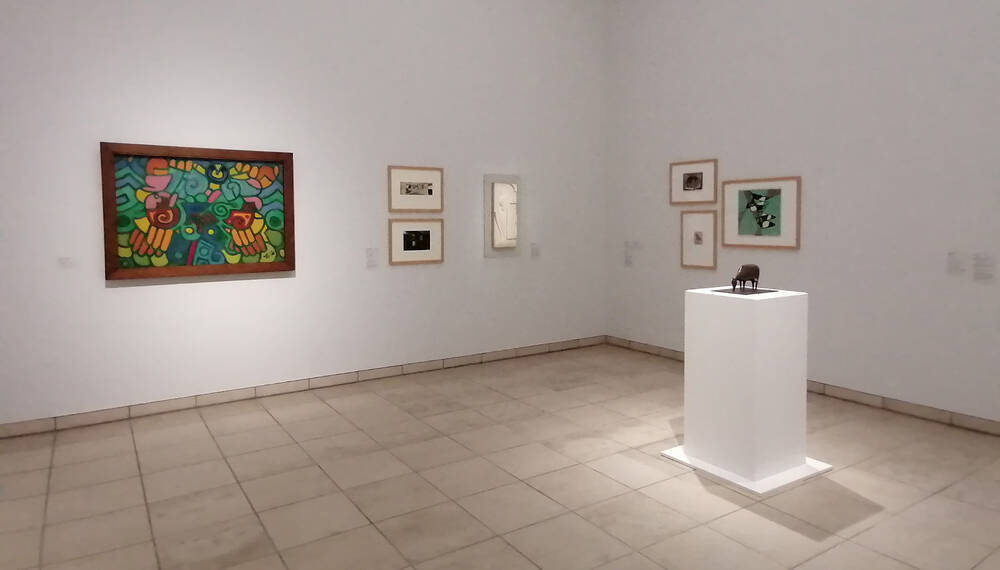
Whilst ornament was regarded merely as decoration – as emotional and feminine – ‘high’ art, by contrast, was expected to be abstract, masculine and intellectual. At least, that was how Wassily Kandinsky saw it. Wilhelm Morgner, on the other hand, was not afraid of ornament. With bold lines, he created ornamental compositions that echo landscape painting.
At the Bauhaus, Paul Klee and Oskar Schlemmer inevitably engaged with the applied arts. Klee, who taught weaving for a time, added the word ‘ornamental’ to the titles of some of his works. As with Matisse, Oriental art proved to be a guiding influence for him. Oskar Schlemmer simplified the human figure to a framework of lines, which he compared to an ornament. During his time at the ‘Lacktechnikum’ in Wuppertal in the early 1940s, he also designed décors that he developed from the human figure.
For Ewald Mataré, too, the idea of ornament was central. However, he was not concerned with the decorative, but with clear and universally valid forms. He believed that in nature, everything is interconnected and interdependent: ‘… it is an immense ornament. I must always try to move from the particular to the general; that is my path.’

Additional Navigation Points
Search Tours
Use the convenient filters to narrow down tours and find the perfect guide for you.
TitleText
Night mode
Reset Settings
Are you sure to reset the Multimedia Guide system to factory settings?
That's how it works!
Erfolge
Nachtmodus
Es werde Nacht
Guide
Tour durchgehört
Home sweet home
Logo 3x klicken
Merkzettel
Nutze den Merkzettel
QR
Nutze den QR-Code-Scanner
Hacker
Objekt 1337 nicht gefunden
Clear bookmarks?
Are you sure to clear the list and remove all objects?
Switch tour
The chosen object is part of another tour. By proceeding you leave your current tour.
Masked Contents
If you choose one of the first two options, terms from historical work titles and handed-down descriptions that are racist or otherwise discriminatory will be displayed. The SKD dissociate themselves from this use of language and stand for a critical examination of it.