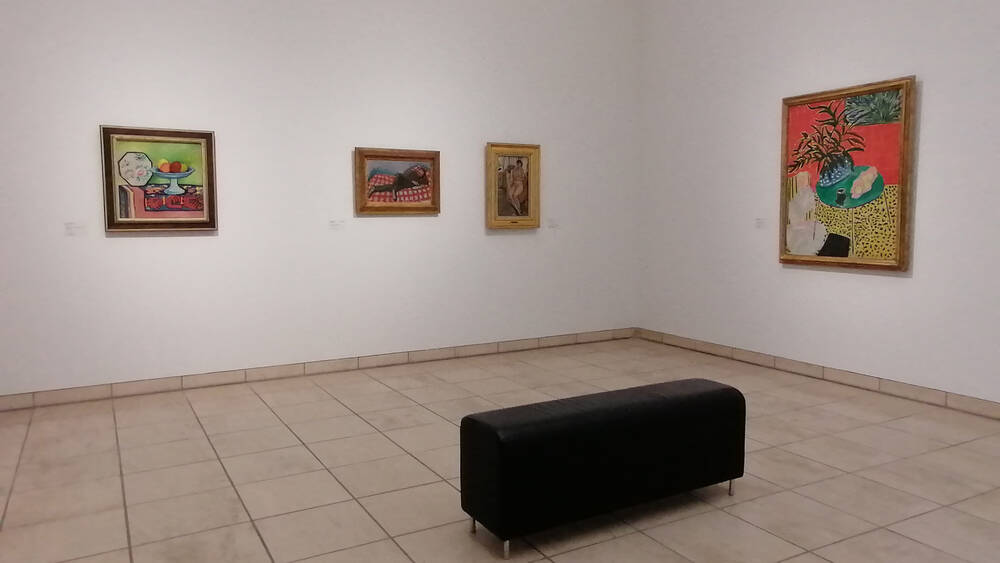
Colourful wallpapers, fabrics and carpets characterised bourgeois interior painting around 1900. They convey the spirit of the age and, at the same time, served to create a sense of spatial depth within the picture. Henri Matisse was an advocate of the decorative in painting. He was particularly inspired by ‘Oriental’ ornamentation. Line and colour complement one another in his paintings.
The works in this room show that painters across Europe drew inspiration from non-European ornamentation, using it to expand their formal repertoire. Whereas for the French artist Édouard Vuillard it is a Persian carpet, for the German August Macke it is North African weaving, and for the Dutch painter George Hendrik Breitner it is a Japanese kimono.
In many paintings, the women's patterned clothing blends with the room's décor. This also reflects the social role of women: the private sphere is the area of life assigned to them, and ornamentation is their field of activity. At the same time, ornamentation was thus excluded from ‘high’ art – an assignment and restriction whose effects are still felt today.


Additional Navigation Points
Search Tours
Use the convenient filters to narrow down tours and find the perfect guide for you.
TitleText
Night mode
Reset Settings
Are you sure to reset the Multimedia Guide system to factory settings?
That's how it works!
Erfolge
Nachtmodus
Es werde Nacht
Guide
Tour durchgehört
Home sweet home
Logo 3x klicken
Merkzettel
Nutze den Merkzettel
QR
Nutze den QR-Code-Scanner
Hacker
Objekt 1337 nicht gefunden
Clear bookmarks?
Are you sure to clear the list and remove all objects?
Switch tour
The chosen object is part of another tour. By proceeding you leave your current tour.
Masked Contents
If you choose one of the first two options, terms from historical work titles and handed-down descriptions that are racist or otherwise discriminatory will be displayed. The SKD dissociate themselves from this use of language and stand for a critical examination of it.