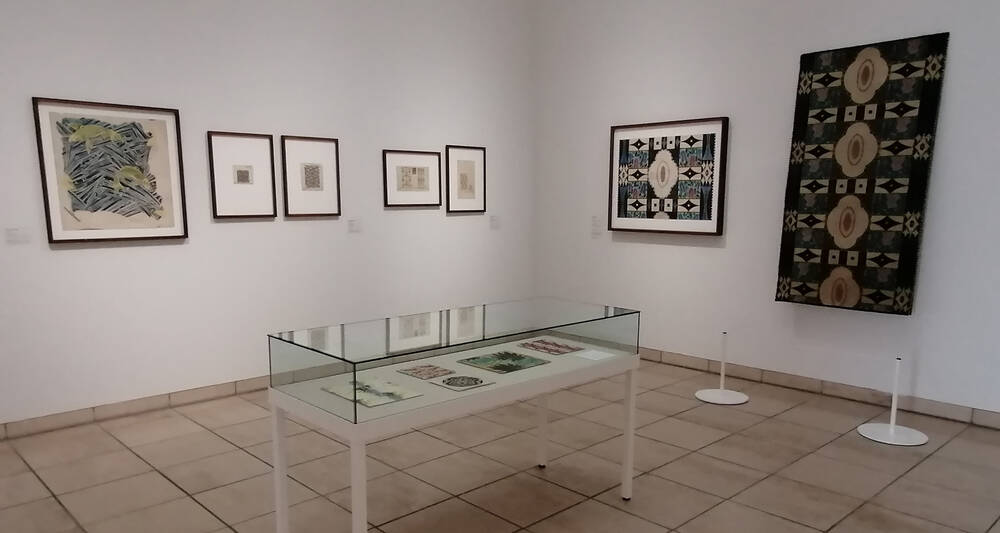
Around 1900, ornamentation was omnipresent: in the arts and crafts, on textiles, and in architecture. The abundance of elaborate, industrially produced decorative elements provoked counter-movements. In Viennese Art Nouveau in particular, there was intense debate about ornamentation. The architect Adolf Loos expressed his criticism of his contemporaries’ preference for decoration in particularly provocative terms in his famous lecture ‘Ornament and Crime’. In response, representatives of the arts and crafts reform movement preferred modern, individually designed ornamentation.
One such production collective was the Wiener Werkstätte, founded in 1903 by the architect Josef Hoffmann and the graphic designer Koloman Moser. The designs exhibited here were produced for the Viennese textile firm Backhausen, which specialised in interior design. In Wuppertal too, in both Barmen and Elberfeld, schools of arts and crafts were established towards the end of the 19th century. Julius Mermagen, for example, a teacher at the Elberfeld School of Arts and Crafts, designed ornamental decorations. He also worked as an independent artist.


Additional Navigation Points
Search Tours
Use the convenient filters to narrow down tours and find the perfect guide for you.
TitleText
Night mode
Reset Settings
Are you sure to reset the Multimedia Guide system to factory settings?
That's how it works!
Erfolge
Nachtmodus
Es werde Nacht
Guide
Tour durchgehört
Home sweet home
Logo 3x klicken
Merkzettel
Nutze den Merkzettel
QR
Nutze den QR-Code-Scanner
Hacker
Objekt 1337 nicht gefunden
Clear bookmarks?
Are you sure to clear the list and remove all objects?
Switch tour
The chosen object is part of another tour. By proceeding you leave your current tour.
Masked Contents
If you choose one of the first two options, terms from historical work titles and handed-down descriptions that are racist or otherwise discriminatory will be displayed. The SKD dissociate themselves from this use of language and stand for a critical examination of it.