
Sigmar Polke (born 1941 in Oels, Silesia – died 2010 in Cologne) is regarded as one of the most influential artists of the post-war period in Germany. In 1963, in Düsseldorf, he, together with Gerhard Richter and Konrad Lueg, proclaimed ‘Capitalist Realism’, an ironic response to consumer culture and the deluge of images. He became known for his grid paintings and his free use of various materials.
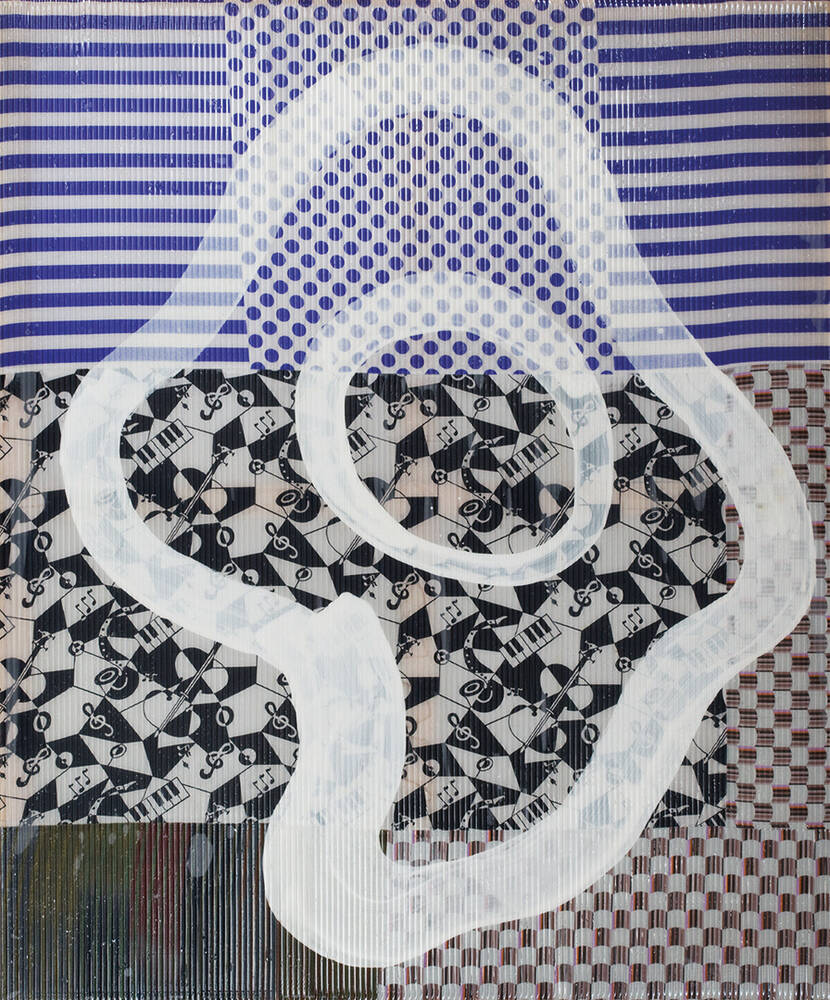
In this work from 2007, he combines different fabrics into a collage reminiscent of patchwork or textile design. Using broad brushstrokes, he applies a white, organically shaped layer of paint to the fabric’s surface, which partly covers the underlying patterns or allows them to show through. The entire surface is covered by a grooved, transparent plastic layer. Isolated air pockets between the layers remain visible as traces of the production process. As early as the 1960s, Polke began working with strikingly patterned everyday fabrics and unusual materials. These were often sourced from carnival shops in the Rhineland.
The work ‘Untitled’ was created as part of Polke’s series of ‘lens pictures’, which he presented in 2007 at the Museum of Contemporary Art in Siegen on the occasion of the Rubens Prize award ceremony. The vertically rippled surfaces made of special plastic or resin, which the artist uses for these works, refract light differently depending on the viewer’s position, creating an effect similar to that of tilt-shift or lenticular images, whereby the subject changes depending on the viewing angle and the movement of the picture surface.
- Location & Dating
- 2007
- Material & Technique
- Mischtechnik auf Stoff
- Dimensions
- 180 × 150 cm
- Museum
- Sammlung Lambrecht-Schadeberg, Museum für Gegenwartskunst Siegen
- Inventory number
- X26.200