


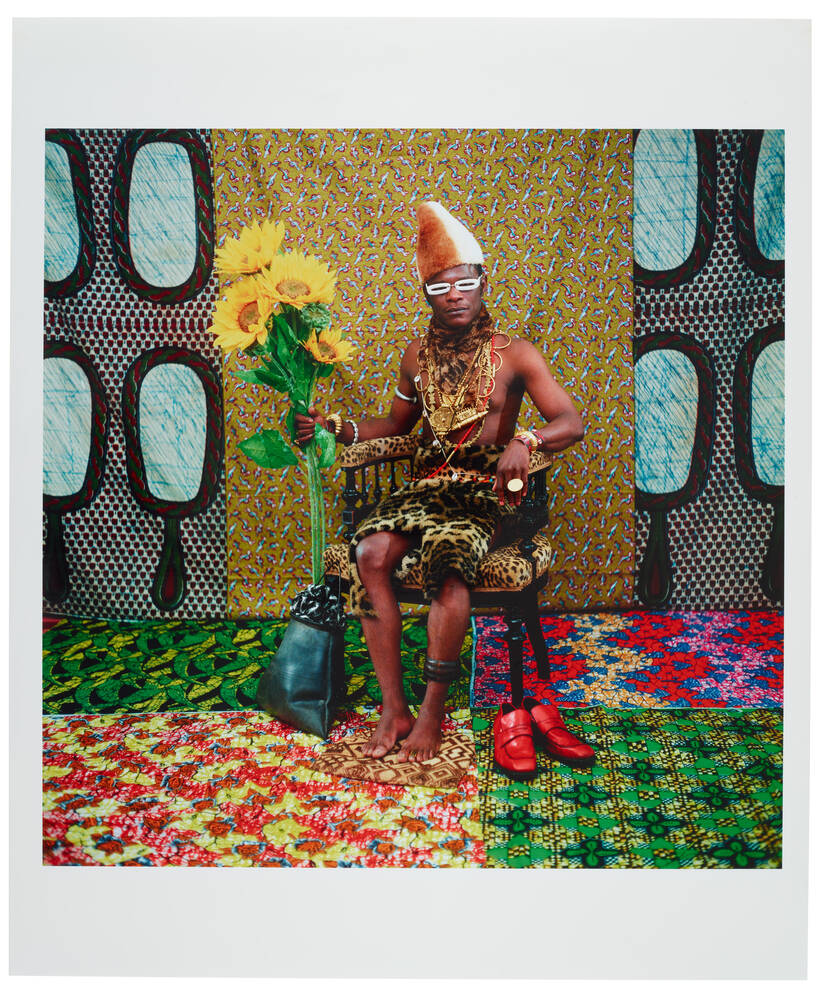
The work ‘Le Chef qui a vendu l’Afrique aux colons’ (Eng. ‘The Ruler Who Sold Africa to the Colonialists’) was created in 1997 as part of a series of photographs that Samuel Fosso produced for the Tati clothing shops in Paris.
Set against an opulent backdrop, Fosso appears as a fictional African ruler, whose headdress is reminiscent of the Congolese dictator Mobutu Sese Seko. Adorned with gold and shell jewellery and draped in leopard skin, he gazes at the viewer through a pair of white spectacles. In his right hand, he holds a bouquet of sunflowers – possibly a sign of his corruptibility. The chair, shoes and leather bag reflect ‘Western’ fashion.
The backdrop is adorned with so-called Dutch wax fabrics. Colourful and richly patterned, these fabrics are often associated with typical African style. In fact, however, the batik technique was invented in Indonesia, mass-produced by Dutch and British colonialists in the 19th century, and exported to West Africa.
It was only after the colonial occupation had been overcome that these fabrics could become an important expression of (West) African culture and national identity. The history of the migration of techniques and patterns is nevertheless inscribed within them.
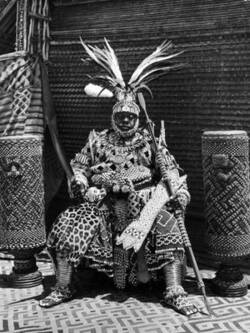
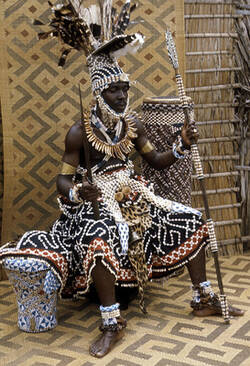
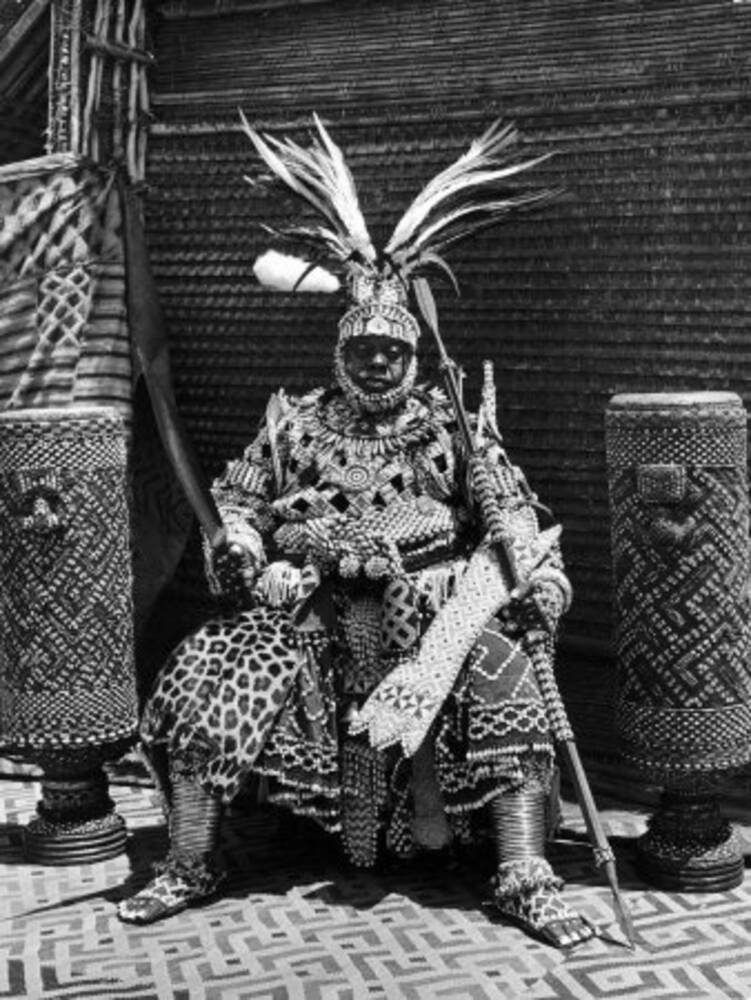
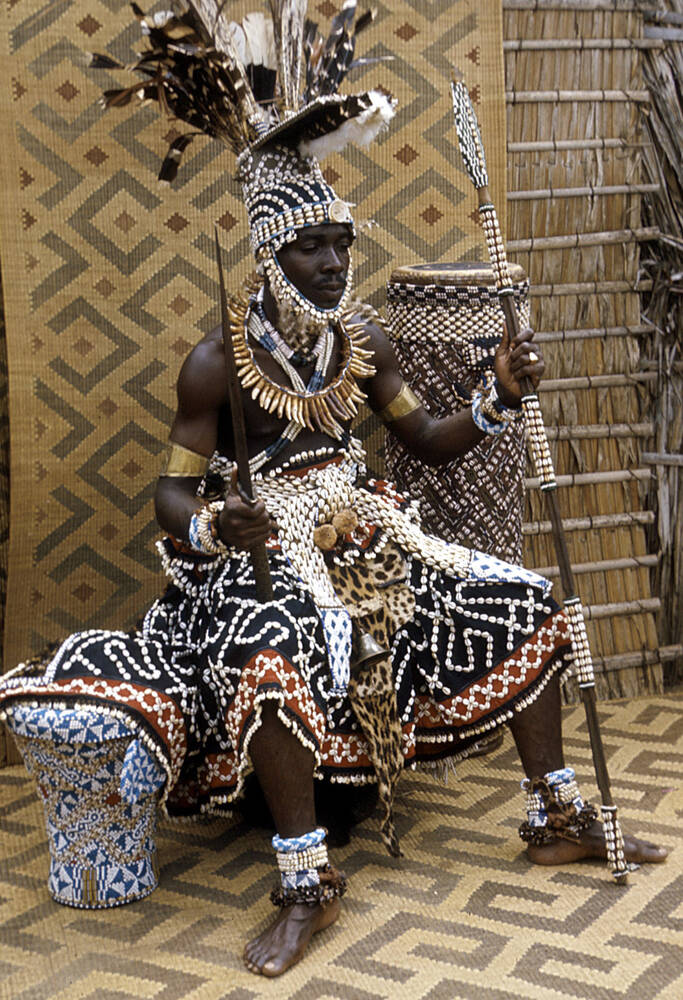
To gain an impression of what was lost as a result of Belgian colonial rule, one can refer to historical photographs of the kings of the Kingdom of Kuba. The Kuba were renowned, for example, for their high level of craftsmanship, particularly their weaving using the leaves of the raffia palm.
Further Media
- Location & Dating
- 1997
- Material & Technique
- Farbabzug auf PE-Papier, Abzug 2003
- Dimensions
- 60,8 × 50,5 cm
- Museum
- Kunstpalast, Düsseldorf
- Inventory number
- X26.198