
In his paintings, Philip Taaffe combines various techniques: screen printing, stencil methods (‘Paper Cuts’), collage, scraping techniques, acrylic glazing and bookbinding techniques such as the use of gold leaf. His motifs draw on a wide range of traditions, from Islamic architecture and Eastern European textile design to calligraphy. He does not simply adopt these individual elements as they are, but recombines them anew from one painting to the next.
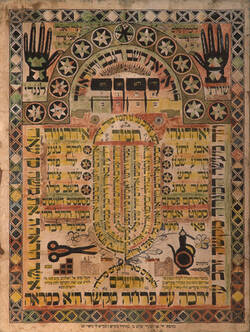
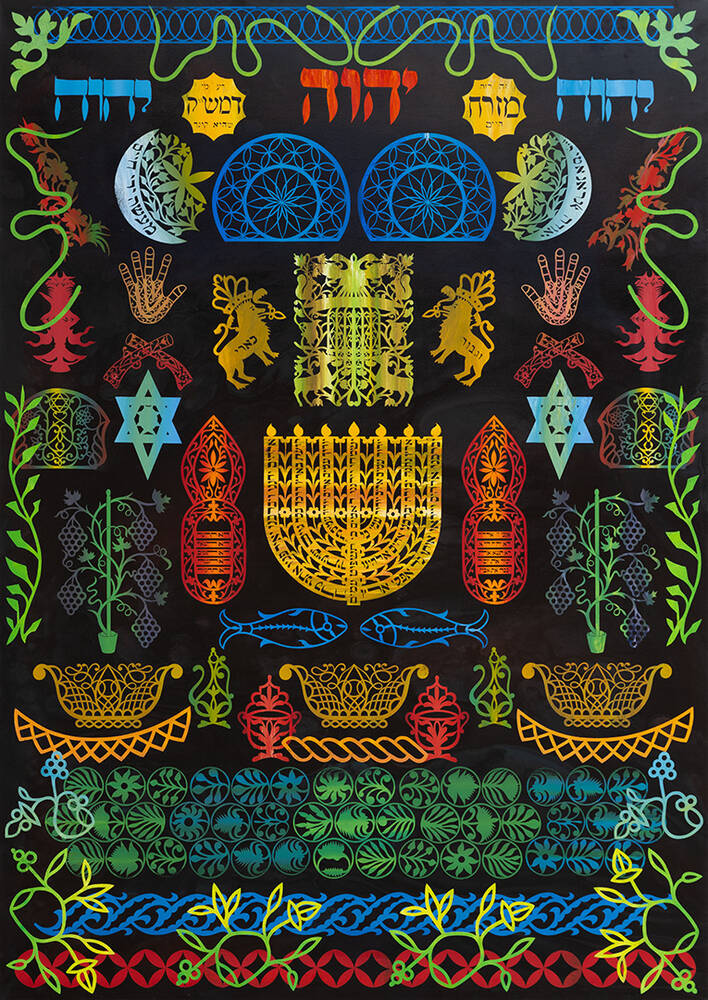
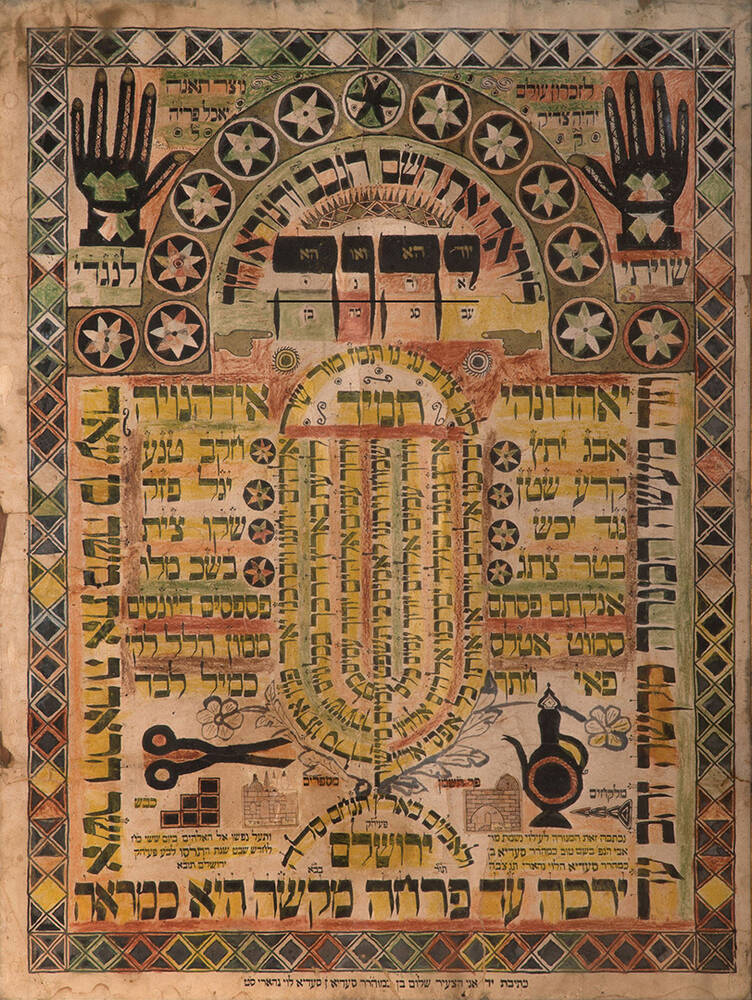
In his work ‘Judaic Painting I’, colourful motifs feature on flowing colour gradients against a dark background. They are reminiscent of the sgraffito technique, in which colours lying beneath are revealed by scraping away an upper layer. Their formal language draws on the Jewish art of paper-cutting found in Mizrach and Shiviti sheets. These traditionally point eastwards – towards Jerusalem – and signify the divine presence.
At the top edge, the Tetragrammaton (YHWH), the sign of God’s presence, appears three times in blue and red. Between them, the words ‘East’ and ‘Damascus’ are inscribed on gold, whilst the crescent moons below contain verses from the Psalms for blessing, protection and well-being in the home. The crowned lions symbolise the Lion of Judah. Both bear small Hebrew inscriptions on their bodies, which refer to a well-known proverb from the Sayings of the Fathers and essentially mean ‘strong and brave as a lion’. They frame the motif of a Torah ark featuring various depictions of animals.
At the centre is the motif of the menorah, the seven-branched candelabrum, whose branches are traditionally inscribed with words from Psalm 67 in tiny script (micrography). It is framed by two red tablets of the Law, on which the Ten Commandments are presumably inscribed in abbreviated form.
Other motifs from Jewish iconography include the Star of David, the Hamsa hand (also known as Yad ha-Chamesh, ‘Hand of Five’ or Hand of Miriam) and vessels containing fruit as symbols of fertility, abundance and thanksgiving for the harvest. The vines depicted on the far left and right of the menorah symbolise, in Jewish iconography, the people of Israel, divine blessing, fertility and messianic hope.
AI note: The Hebrew text has been translated using AI. The accuracy of the translations cannot be guaranteed.
Further Media
- Location & Dating
- 2019
- Material & Technique
- Mixed Media auf Leinwand
- Dimensions
- 320,7 × 227,3 cm
- Museum
- Jablonka Collection
- Inventory number
- X26.194