


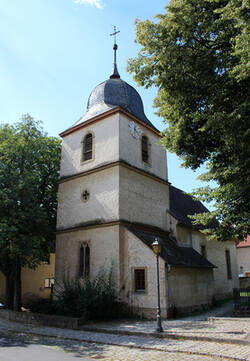
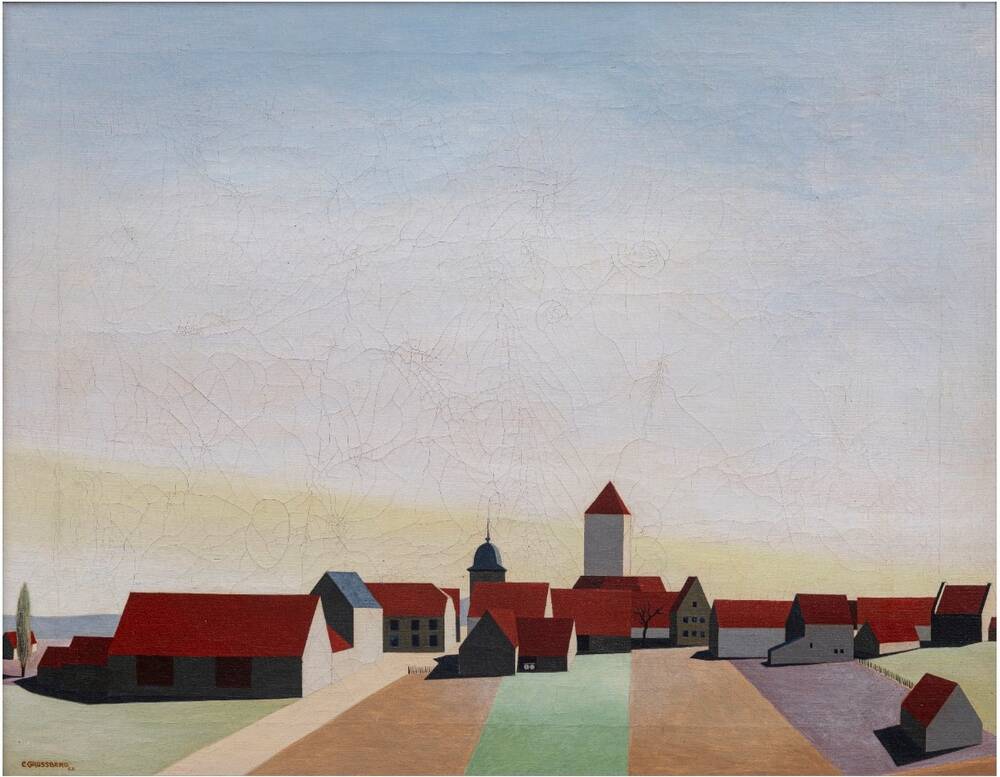
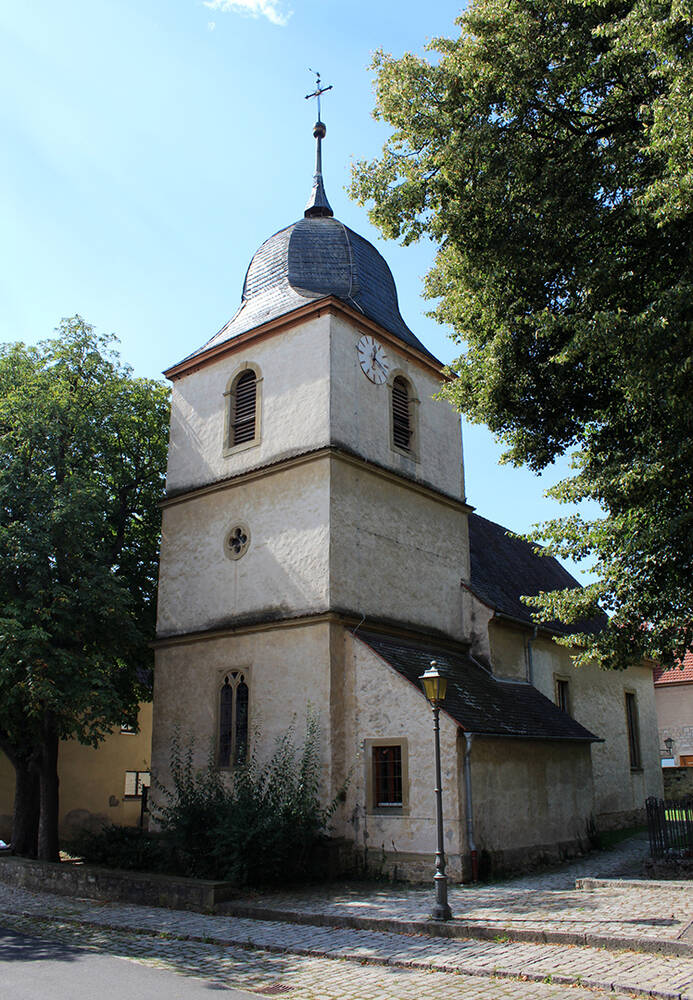
Most of this 1925 painting is taken up by the sky. In the lower section, a yellow area can be seen, above which is a grey-white zone, which is the largest area and transitions into light blue. The horizon lies roughly in the bottom quarter of the painting. The village landscape that gives the painting its title consists of a few red-roofed cubic houses designed like building blocks, with no further detail. Dark shadows fall to the left. Therefore, the invisible sun must be to the right, outside the picture space. The fields in the foreground consist of different coloured areas and converge towards a vanishing point behind the cubic tower. This represents the highest point in the painting. However, the actual landmark of the small community of Erlach is the tower of St John's Simultaneous Church, which appears rather inconspicuous here. The core of the three-storey choir tower probably dates from the 14th century. The nave, which originally only extended to the beginning of the gallery, was extended in 1793. The tower is topped with a bell dome, the shape of which is clearly visible in the painting.
Grossberg chose a distant vantage point and reduced the village to its essentials. The buildings form a group in which none is particularly emphasised. This style of representation can often be seen in the painter's city and village views.
Further Media
- Location & Dating
- 1925
- Material & Technique
- Öl auf Leinwand
- Dimensions
- 38 x 48 cm
- Museum
- Privatsammlung
- Inventory number
- X26.093