


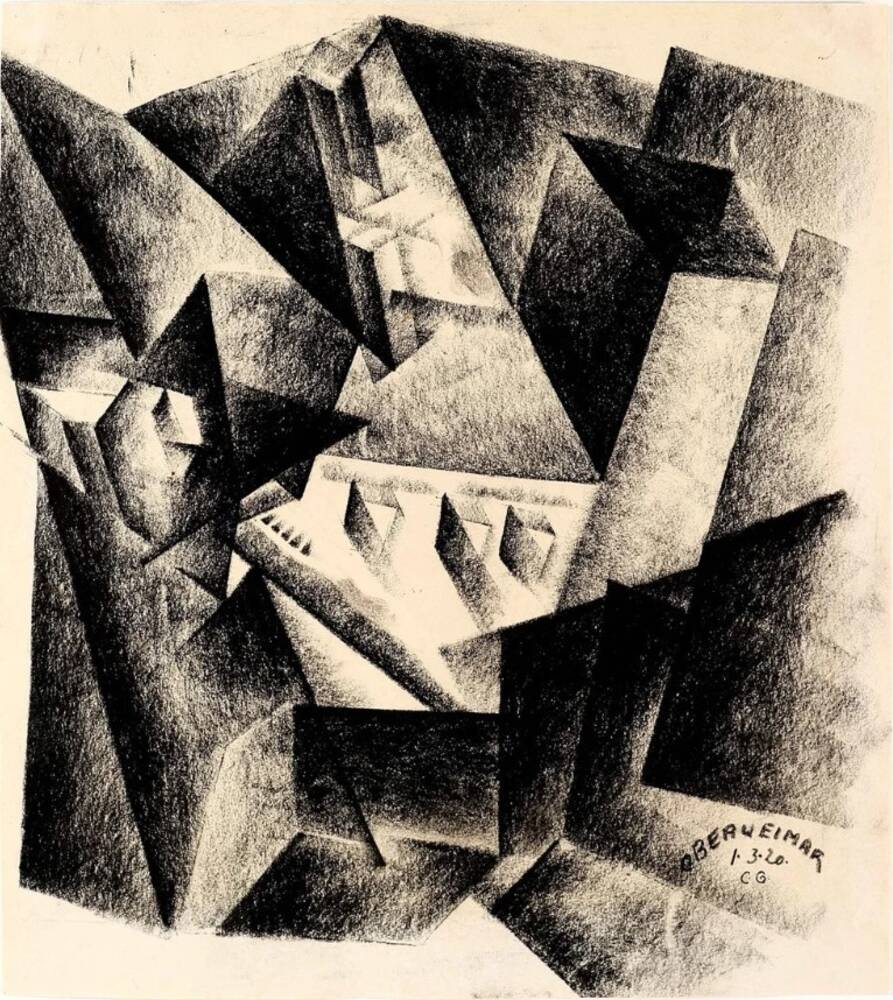
On 30 January 1919, Grossberg was admitted to study at the Großherzoglich-Sächsische Hochschule für Bildende Kunst (Grand Ducal Saxon Academy of Fine Arts) in Weimar. After it merged with the Großherzogliche Kunstgewerbeschule (Grand Ducal School of Applied Arts) and was renamed the 'Staatliches Bauhaus Weimar' (State Bauhaus Weimar), Grossberg initially enrolled there as a probationary student in March 1919. After a one-year probationary period, he was officially admitted on 30 March 1920 and thus became part of the first generation of Bauhaus students. Shortly before this, on 1 March 1920, he created the present charcoal drawing.
This dense scene impresses with its angular, geometric style of representation and straightforward, contrasting forms that – greatly simplified – depict buildings. Grossberg skilfully used charcoal to create light-dark contrasts and lighting effects. In contrast to the almost crystalline forms, he added the title in rounded letters: 'Oberweimar' (Upper Weimar), a district in the south-east of Weimar. The design of the drawing not only ties in with the Cubism of previous years, but also brings Grossberg closer to his Bauhaus teachers in terms of style. He completed the preliminary courses with Paul Klee and Johannes Itten and then continued his studies under Lyonel Feininger. In March 1921, Grossberg left the Bauhaus in disappointment, probably following disagreements with Walter Gropius.
- Location & Dating
- 1.3.1920
- Material & Technique
- Bleistift auf Papier
- Dimensions
- 33 x 29 cm
- Museum
- Merrill C. Berman Collection, Rye, New York
- Inventory number
- X26.066