


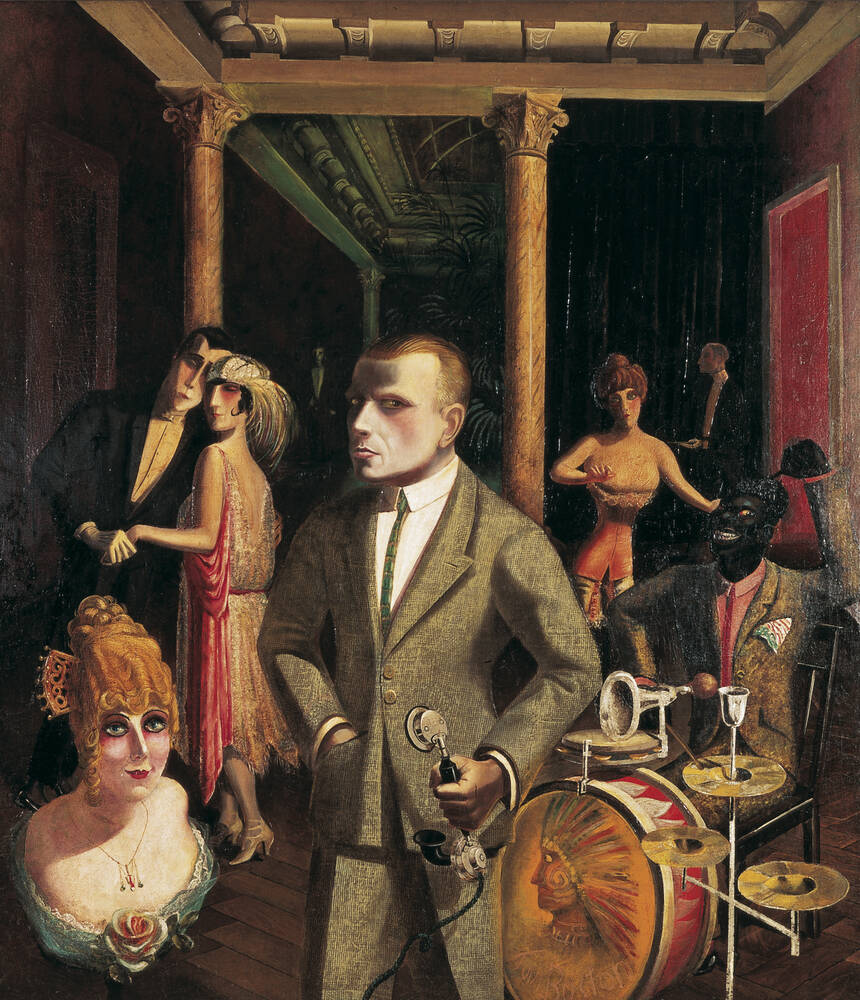
Otto Dix places his self-portrait as a knee-length figure at the centre of an evening dance scene. Behind him, the space is filled with dolls and people: dancers, drummers, waiters, and a decorative bust. A cold spotlight highlights the face of the thirty-year-old from the semi-darkness. Like a signal, the pointed triangle of his white shirt precisely marks the centre of the picture, and emphasises his central role. Looking directly at the viewer from the corner of his eye, Dix appears serious and sober. The telephone receiver in his left hand underlines his detachment from the dancing and the traditional role of the artist. This modern connection to the outside world marks him out as a reporter and a 'realist', a term he would later use to describe himself.
Initially a co-founder of the 'Dresden Secession Group 1919', Dix came into contact with the Dada movement in 1920 and moved to Düsseldorf in 1922 — the year of this self-portrait — where he joined the avant-garde group 'Das Junge Rheinland' (The Young Rhineland). In 1927, he returned to Dresden as a professor at the academy. His figurative paintings from this bourgeois phase reveal a tendency towards old master-style, mannerist realism. His portraits were highly prized by collectors and museums. In 1933, he was among the first to be removed from his position by the Nazi regime. He survived the period of prohibition in rural seclusion, in internal exile.
'To Beauty' is also the title of a poem by the Alsatian poet Ernst Stadler, who became a leading figure of Expressionism with his collection of poems 'Der Aufbruch' (The Departure).
- Location & Dating
- 1922
- Material & Technique
- Leinwand (doubliert)
- Dimensions
- 139,5 x 120,5 cm
- Museum
- Von der Heydt Museum
- Inventory number
- G 1340