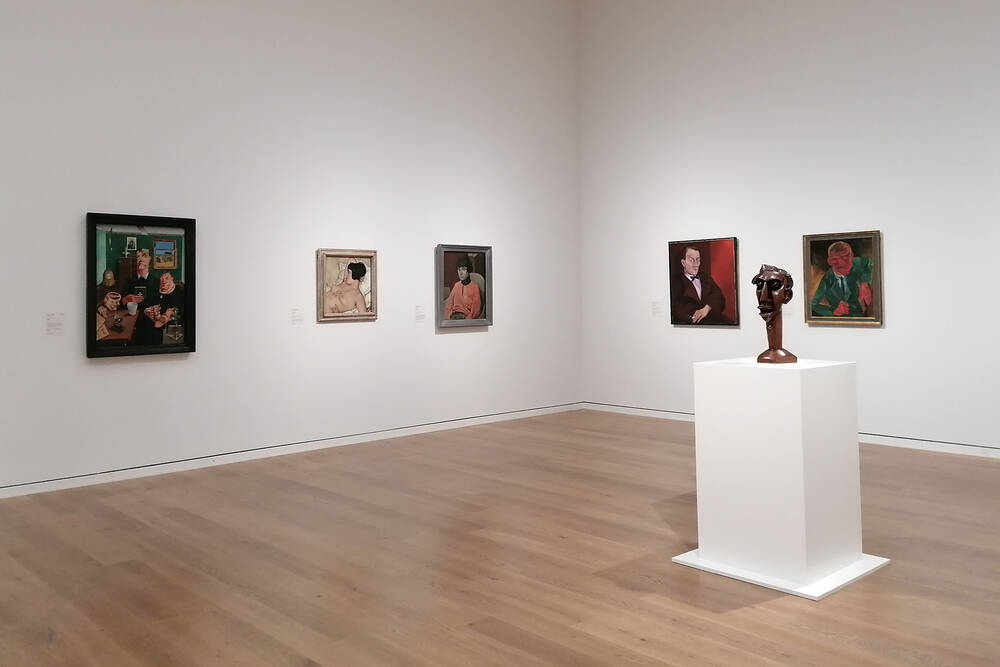


The early 1920s were marked by the horrors of World War I and the profound changes that followed. It was a time of upheaval, disorientation, and new beginnings—conditions that also had a direct impact on the work of artists. The idealistic attitude that had prevailed at the beginning of the 20th century gave way to skeptical realism.
Art was characterized by socially critical themes, a sober view without pathos, and a realism that was sometimes down-to-earth, sometimes drastic. At the same time, photography became an increasingly important medium. The themes of industry and technology came increasingly into focus.
The term “New Objectivity” developed around 1925. Gustav F. Hartlaub used it for an exhibition at the Kunsthalle Mannheim, while Franz Roh attempted to distinguish the new artistic movements from the Expressionism of the pre-war period with the term “magical realism.” Prominent representatives of New Objectivity include Otto Dix, Conrad Felixmüller, Franz Radziwill and Carl Grossberg. Max Beckmann, whose works can be found in our collection, is also included in this group.
The “Cologne Progressives,” which included Heinrich Hoerle, Franz Wilhelm Seiwert, and Gerd Arntz, formed a counterpoint to New Objectivity. The group was one of the most important artistic and political movements of the Weimar Republic.