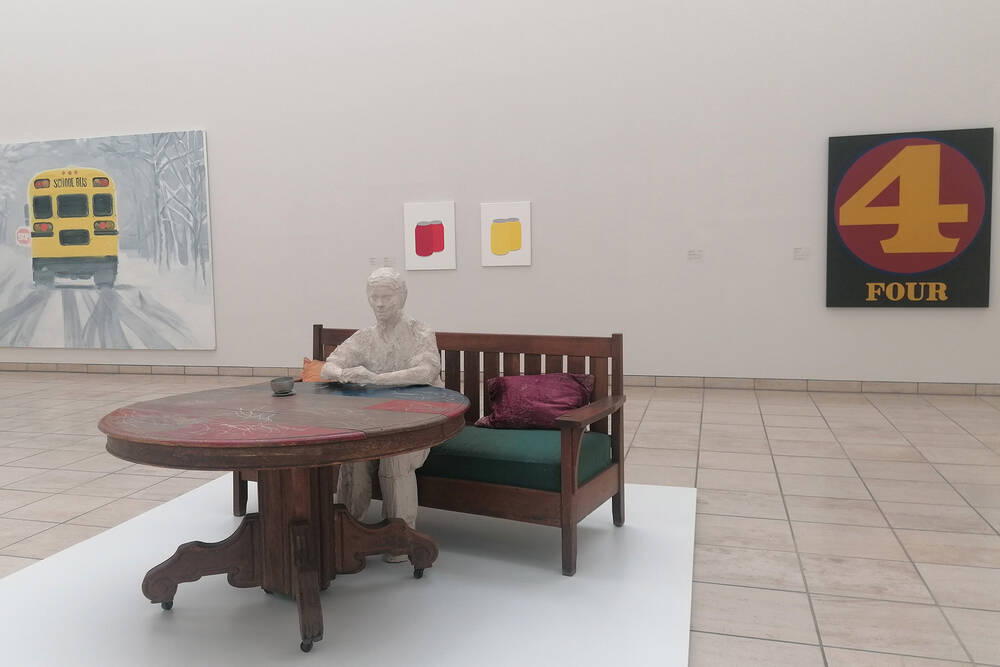


Immediately after the Second World War, artists felt compelled to work in an abstract or gestural style. By detaching themselves from the object, they freed themselves from an art form that had been ideologically abused, especially by the Nazis.
American Pop Art marked a turning point in the early 1960s. It brought realism back in a new form: everyday objects and consumer goods, even the striking aesthetics of advertising, became worthy of representation, and ordinary materials and objects found their way into works of art. The response from Europe was not long in coming, as evidenced by the works of British artist David Hepher, Italian artists Domenico Gnoli and Ettore Colla, and German painter Konrad Klapheck. Klapheck's Dingmagie (Magic of Things) referred directly to Carl Grossberg.
Since then, engaging with visible reality has been a natural option for artists. Sometimes, as in the case of Dirk Skreber, this happens in an almost explosive way; sometimes, as in the case of Markus Willeke, it is so disciplined, despite all the painterly freedom, that the image, however representational it may be, can also be read abstractly. Torsten Slama, on the other hand, ties in directly with Grossberg in terms of both motif and form. With his painting “Rumpf-Familie” (Trunk Family, 2008), he quotes Grossberg's Dream Picture “Dampfkessel mit Fledermaus” (Steam Boiler with Bat).