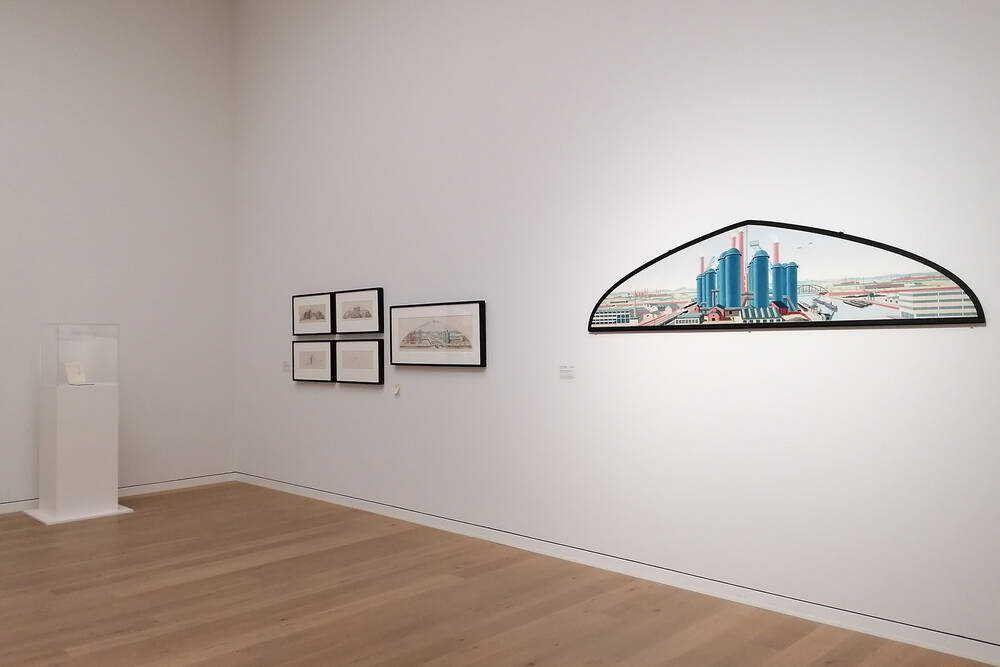


From 1929 to 1931, Grossberg created a portfolio of prints for Berliner Elektrizitätswerke (BEWAG) documenting the construction of a new power plant, from the preparation of the excavation pit to its completion. The prints alternate between panoramic views of the landscape and detailed interior views.
The large-format “Industrial Landscape,” which combines motifs mainly from the industrial regions of West Germany, reflects Grossberg's preoccupation with industry and technology. It was used as a template for a mural for the exhibition “Deutsches Volk – Deutsche Arbeit” (German People – German Work) in 1934. The client was the Reich Ministry of Public Enlightenment and Propaganda. However, the picture should not be understood as an endorsement of National Socialism. Grossberg and his wife were considered opponents of the regime and were denounced as “communists.” When he accepted government commissions, it was to support his family.
Grossberg's personal view of current events and his emotional distress can be seen in a visionary painting from 1932/33, which is being exhibited publicly for the first time here: a lonely human figure is threatened by technological and industrial progress as well as by snarling fantasy creatures. At the same time, Grossberg drew a “tightrope walking machine with shadows” in a sketchbook as a symbol of his difficult situation. Beneath it is the date January 30, 1933—the day Adolf Hitler was appointed Reich Chancellor.