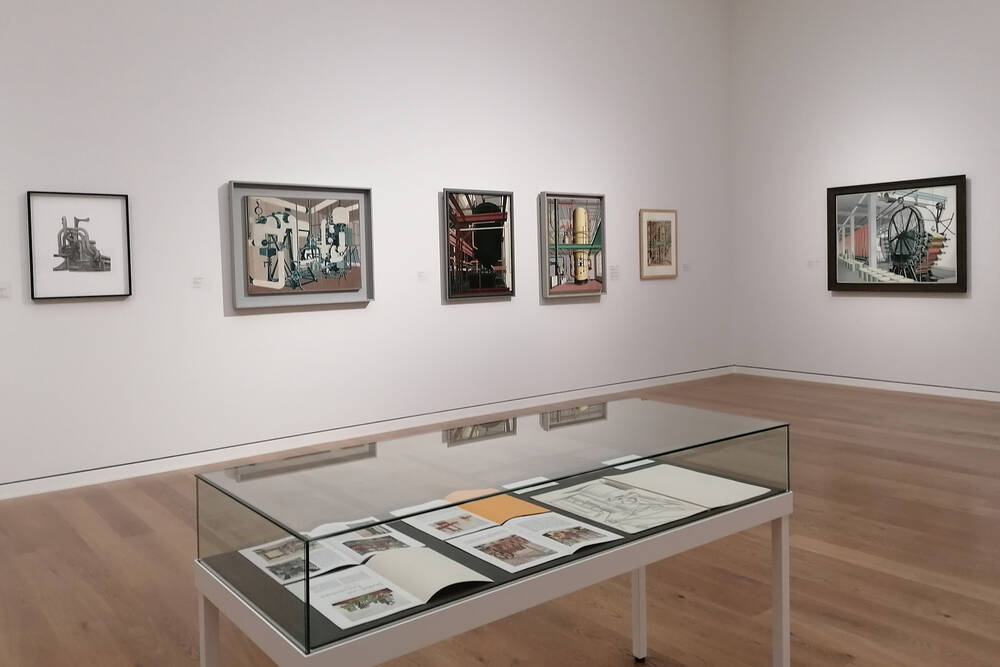


Grossberg painted his first machine picture in 1924: “Still Life with Turbine.” In the same year, he received his first industrial commission from the Würzburg-based printing press manufacturer Koenig & Bauer.
In the late 1920s, motifs from technology and industry became dominant in Grossberg's work and its public perception. In 1928–29, he was prominently featured in two themed exhibitions on “Art and Technology”: at the Museum Folkwang Essen and at the Verein Berliner Künstler (Berlin Artists' Association). This was followed by commissions for series of paintings from large industrial companies. For example, he drew and painted the production facilities and rooms of the Hamburg oil factory Brinckmann & Mergell (HOBUM), the Hamburg coffee roastery Brehmer & Wagner, and the weaving mill Pott & Hinrichs in Wuppertal-Elberfeld.
From 1933 onwards, Grossberg pursued the idea of an “industrial plan”: a closed group of 15–20 pictures that would travel around Germany and bring him attention and further commissions. He was unable to realize this plan. From 1934 to 1939, he regularly provided illustrations on the themes of technology and industry for Westermann's Monatshefte.
Grossberg's detailed depictions appear almost photographic. And indeed, they are often based on photographic models. With their clear colors, tight composition, and absence of people, they paint an ambivalent picture of progress.