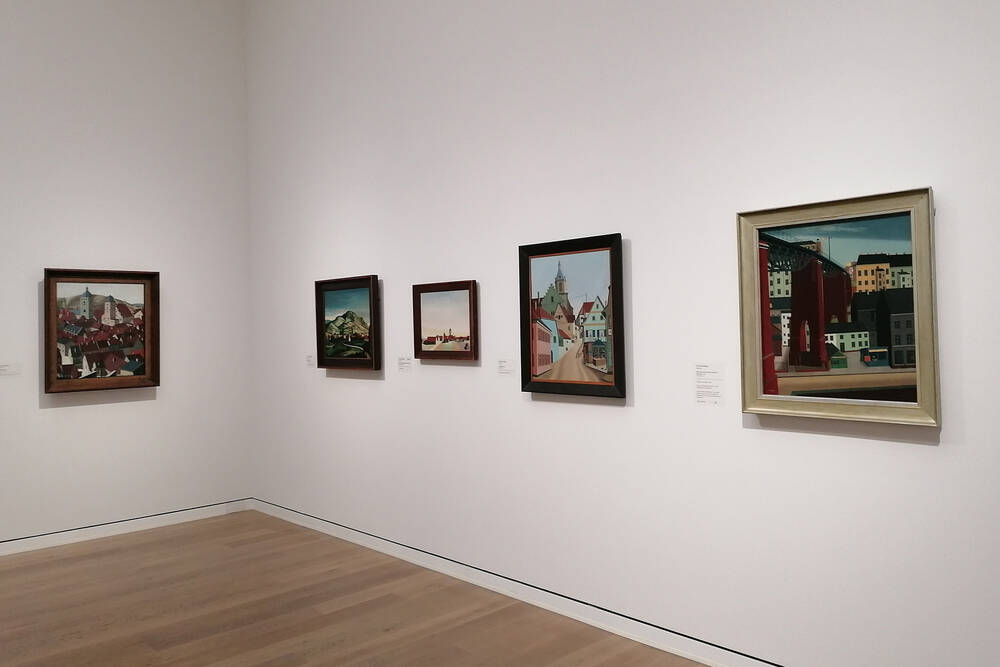


It is difficult to identify clear phases in Grossberg's oeuvre, as he worked on different themes in parallel. His architectural, industrial, and urban views emerge alongside his “Dream Pictures.”
He alternates between metropolitan and rural subjects, both in paintings and works on paper. In his paintings, he depicts houses and towers in a cubic style, choosing bold colors and varying the perspective and viewer's point of view. Grossberg applies the paint in a very smooth manner, reminiscent of the old masters, without any discernible brushstrokes. The effect is almost mechanical. In his watercolors, the tone and texture of the paint take on greater significance, and the application seems almost playful. The lines are also freer and more lively.
Similar motifs are popular in contemporary photography, as the pictures by Albert Renger-Patzsch and August Sander prove. Renger-Patzsch's photographs from Essen and Duisburg, not far from Grossberg's birthplace of Elberfeld, were taken in 1930 and 1932 respectively and display a similarly cool, objective style. In the 1930s, Sander photographed villages in the Westerwald and landscapes in lignite mining areas. Like his famous portraits, they are characterized by a documentary style. The “New Vision” of objective photography corresponds to Grossberg's objective painting.