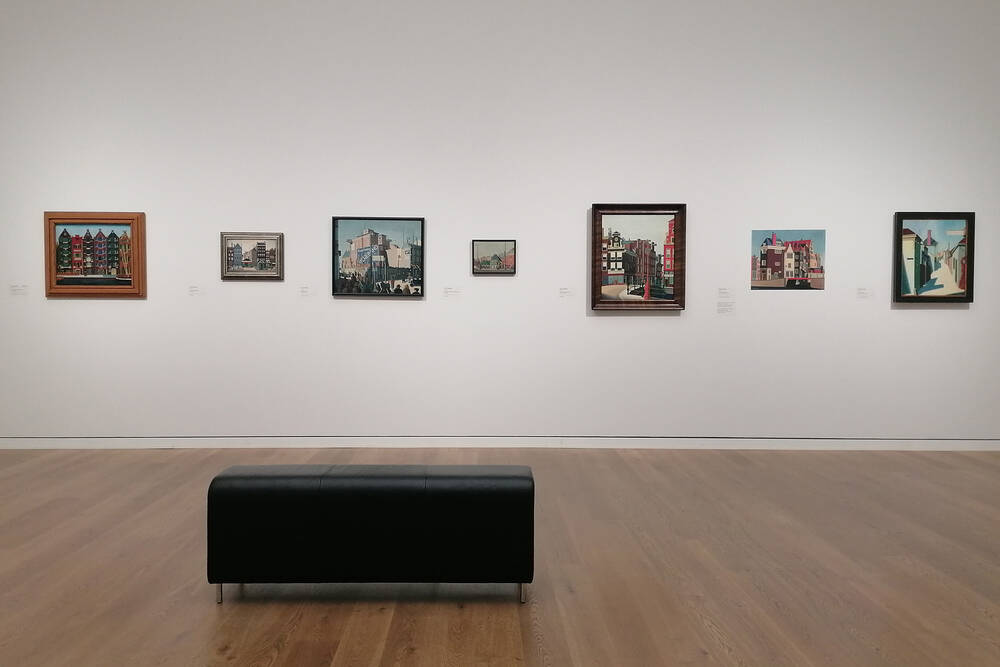


In 1921, Grossberg moved to Sommerhausen, south of Würzburg, an idyllic wine-growing village where he remained until 1940. In 1923, he married Mathilde (Tilde) Schwarz, a violinist from the village. Sommerhausen, Würzburg, and many surrounding villages feature in his works. Nevertheless, Grossberg was repeatedly drawn to the big cities, especially Berlin, where he joined the “Verein Berliner Künstler” (Berlin Artists' Association). His life and work were thus equally influenced by the contrast between city and country: modern industrial life on the one hand and a traditional, quiet rural existence on the other.
In the summer of 1925, Grossberg and his friend Gustav Decker undertook a two-week study trip to Amsterdam and Zandvoort. This led to formal clarification in his work. Since then, his paintings have been characterized by geometric sharpness and unusual, radiant colors.
A comparison with the photography of Thomas Ruff reveals exciting parallels spanning more than half a century: the standardized architecture, the perspective and the fragmentary nature of the images, as well as the absence of people. Ruff, who studied with Bernd and Hilla Becher in Düsseldorf, is influenced by the objective architectural photography of the Bauhaus – an important point of reference for Grossberg as well.