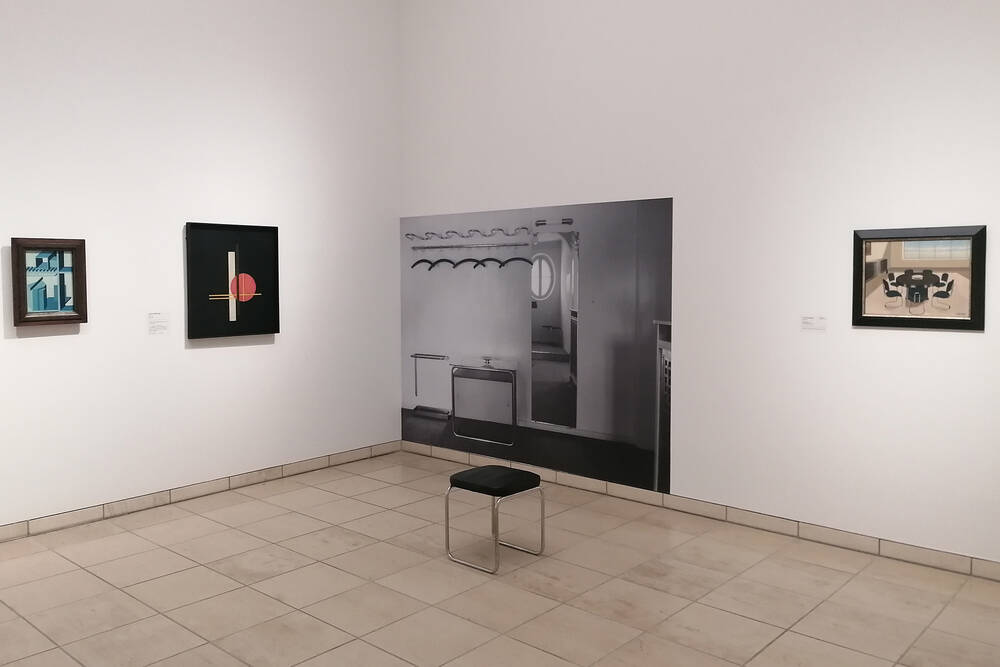


As a student at the Bauhaus, Grossberg saw himself as a painter and did not conform to the school's philosophy of uniting all arts in “Bau” (building). Nevertheless, after leaving Weimar, he emphasized his commitment to the “Bauhaus idea,” i.e., the goal of designing the modern living environment in a contemporary manner.
From 1927 onwards, the teachings and attitude of the Bauhaus were reflected in a series of architectural projects with which Grossberg supplemented his income during difficult economic times. Undoubtedly, his training as an architect at the universities of Aachen and Darmstadt in 1913–14, which he had to interrupt due to the First World War, also benefited him in this regard.
Grossberg collaborated with renowned architects on larger projects, including Erich Mendelsohn, one of the most important representatives of modern architecture in Germany, in Berlin. For a time, he ran his own office in Nuremberg, where he designed interiors for wealthy private individuals, many of whom were of Jewish origin.
The great commercial success of Grossberg's single-color wallpaper can also be explained by the artist's painterly sensibility. He designed it in 1931 for the North German wallpaper factory Hölscher & Breimer (NORTA) in Langenhagen near Hannover.