

In the spring of 1919, Grossberg enrolled at the Academy of Fine Arts in Weimar. A few weeks later, the academy merged with the State Bauhaus Weimar, which declared architecture to be its leading discipline. In the words of its first rector, Walter Gropius: “The ultimate goal of all artistic activity is construction!”
Grossberg himself had begun studying architecture before the First World War. Nevertheless, at the Bauhaus he remained true to the goal he had gone to Weimar with: he wanted to become a painter. His most important teacher was Lyonel Feininger. He also attended courses taught by Paul Klee and Johannes Itten. In March 1921, he announced his departure from the school—in connection with a deep crisis that had been sparked by Walter Gropius's management style.
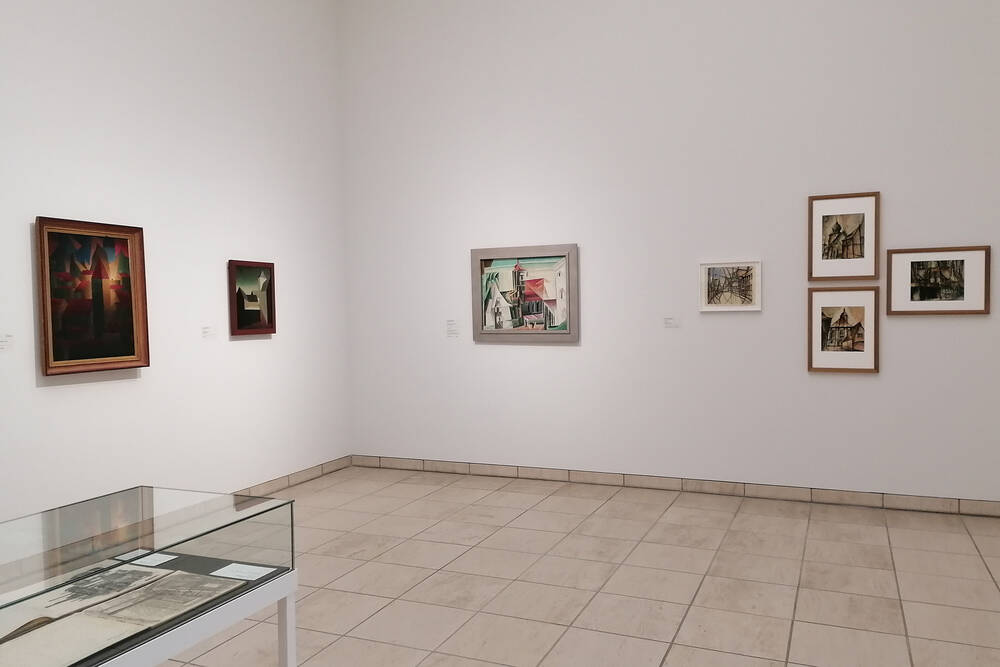
The works on paper from his Weimar years show how much Grossberg owed to his teaching there. The influence of Feininger is particularly evident in those sheets in which he arranges the motifs geometrically or dissolves them crystalline. Klee and Itten may have sharpened his sense of color, which is particularly evident in his watercolors. In oil paintings depicting simplified, modular buildings, he coherently synthesizes the contrasting influences he receives and finds his own position: solid forms meet clear colors.