


Richard Oelze (1900–1980) started his artistic career with a lithography apprenticeship, before studying at the Bauhaus in Weimar and Dessau from 1921 to 1925. He then continued his training at the Dresden Art Academy under Otto Dix.
In 1933, the artist, born in Magdeburg, moved to Paris, where he met the Surrealists André Breton, Max Ernst, Yves Tanguy and Salvador Dalí. These experiences had a long-lasting impact on his artistic style. He exhibited his work at important international exhibitions, including documenta II and III in Kassel and the Venice Biennale in 1968. Oelze is regarded as one of the most important representatives of surrealism in Germany.
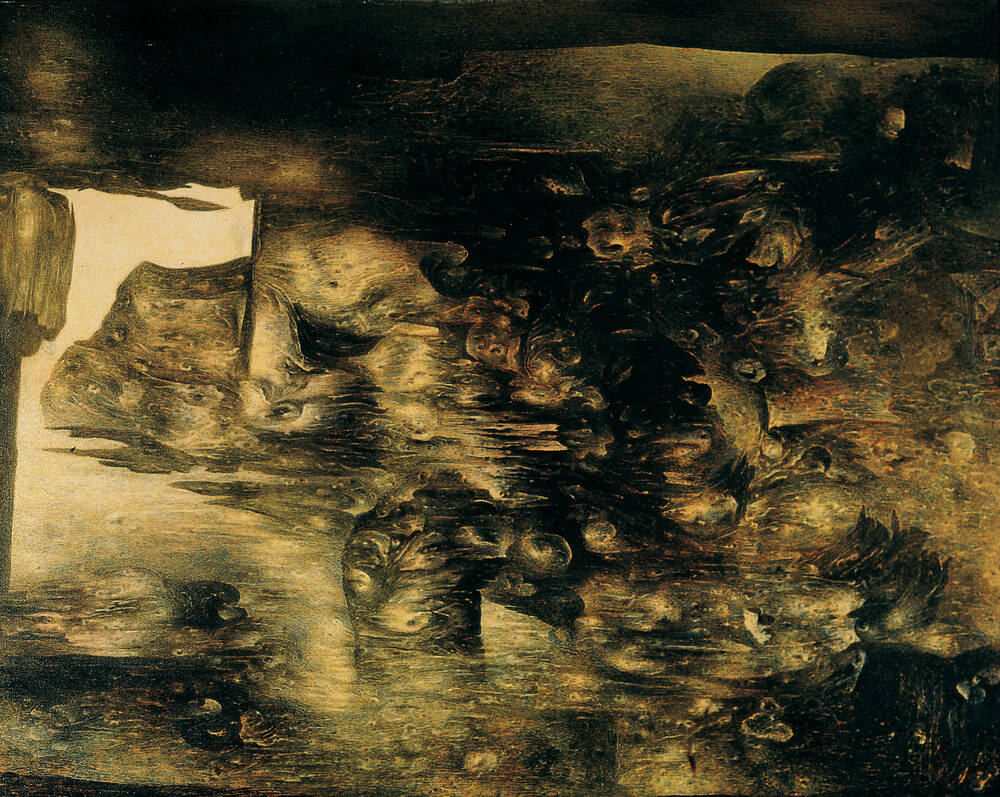
His paintings are characterised by a combination of abstract structures and representational motifs, which can be seen in his 1960 work “Black Lake”. It was created in Worpswede, where Oelze lived after World War II. In 1963, the painting entered the Wuppertal collection. It depicts a detailed landscape typical of Oelze's art, balancing abstraction with a surreal vision. The title evokes associations with a mysterious underwater world that is both dark and dreamlike. In the imaginative structures – which, in addition to swirling sand, are also reminiscent of tree bark or stalactite caves – shadowy, almost human figures appear before the viewer's eye. However, they immediately dissolve again and merge with their surroundings.
- Location & Dating
- 1960
- Material & Technique
- Leinwand
- Dimensions
- 80,5 x 100 cm
- Museum
- Von der Heydt Museum
- Inventory number
- G 1104