


Originally from the Rhineland, Max Ernst (1891–1976) is widely regarded as one of the most influential artists of the 20th century. He was a co-founder of the Cologne Dada group and later a protagonist of Surrealism, which he joined in Paris in 1922, and was a driving force behind both movements. He based his artistic work on the subconscious, resulting in unexpected and unusual forms and content.
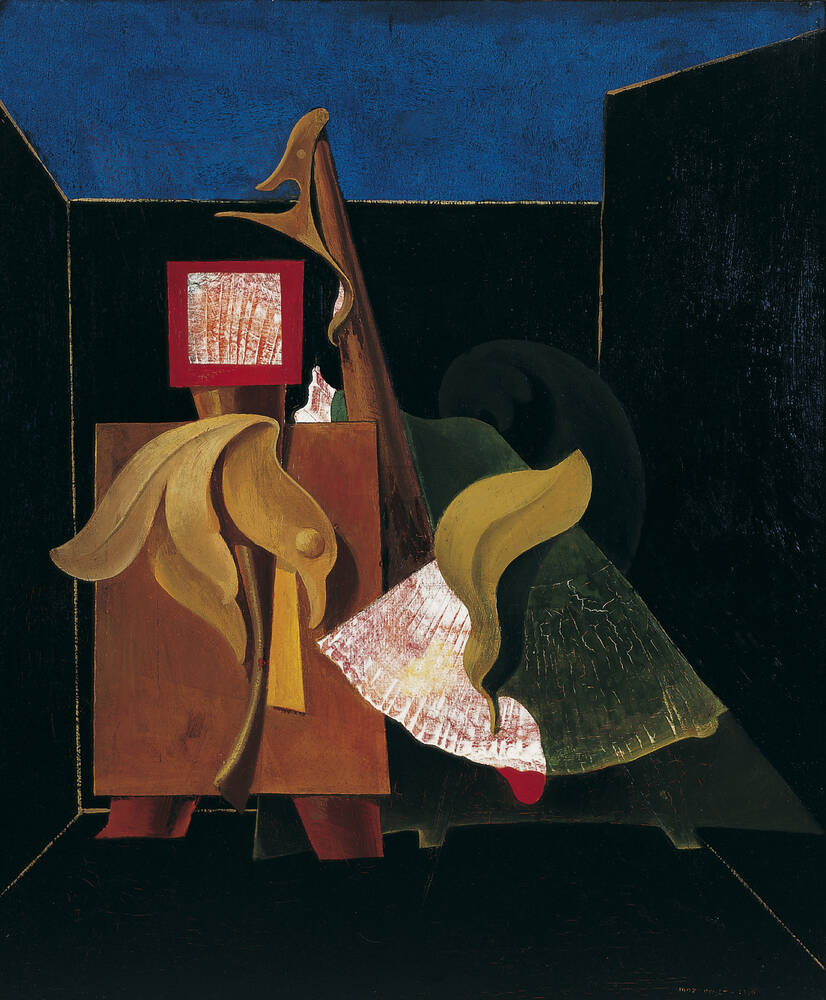
In 1930, he painted “Two Anthropomorphic Figures”. Two figures, composed of fragmentary forms, appear in a black, box-like room. The figure on the left consists of brown-red rectangles and a yellow, bird-like element, and is depicted facing the viewer. The secondary figure is composed of brown-green shapes. It embraces its partner, gathers its robe and stretches its long neck, adorned head facing the dark blue sky. Formally, the figures appear contrasting, connected only by the yellow organic shapes reminiscent of birds and leaves.
Bird imagery played a central role in Ernst's work around 1930. Bird eyes, profiles, and references to his “private phantom” Loplop can be found in many paintings from this period, and it is from this source that the anthropomorphic couple derives its liveliness.
Ernst viewed his art as a journey of discovery into the subconscious that was always connected to the outside world. He assigns an active role to the viewer: only by overcoming passive viewing can the “primordial breath of reality” be perceived in the “absurd irrationality” of Surrealism.
- Location & Dating
- 1930
- Material & Technique
- Öl auf Leinwand
- Dimensions
- 66 x 54 cm
- Museum
- Kunst- und Museumsverein
- Inventory number
- KMV 1963-64/11