


The title of the painting itself refers to two famous 19th-century works. The Spanish surrealist Salvador Dalí (1904–1989) was inspired by “The Angelus” (1859) by French realist Jean-François Millet and “The Isle of the Dead” by Swiss symbolist Arnold Böcklin (several versions of which were created between 1880 and 1886) . Both paintings capture the viewer with their quiet, almost eerie atmosphere. In Böcklin's painting, a rocky island rises out of calm waters. A boat carrying a coffin and a figure shrouded in white approaches the island under a dark sky.
Millet's painting seems more mundane: a peasant couple have interrupted their work, leaning over a basket of potatoes in prayer. However, this image also exudes a peculiar tension. It became an icon in France and was even vandalised in the Louvre in 1932. Dalí spent years studying Millet's depiction. He wrote a book about it and revisited the motif repeatedly in his paintings, including in his adaptation of The Isle of the Dead.
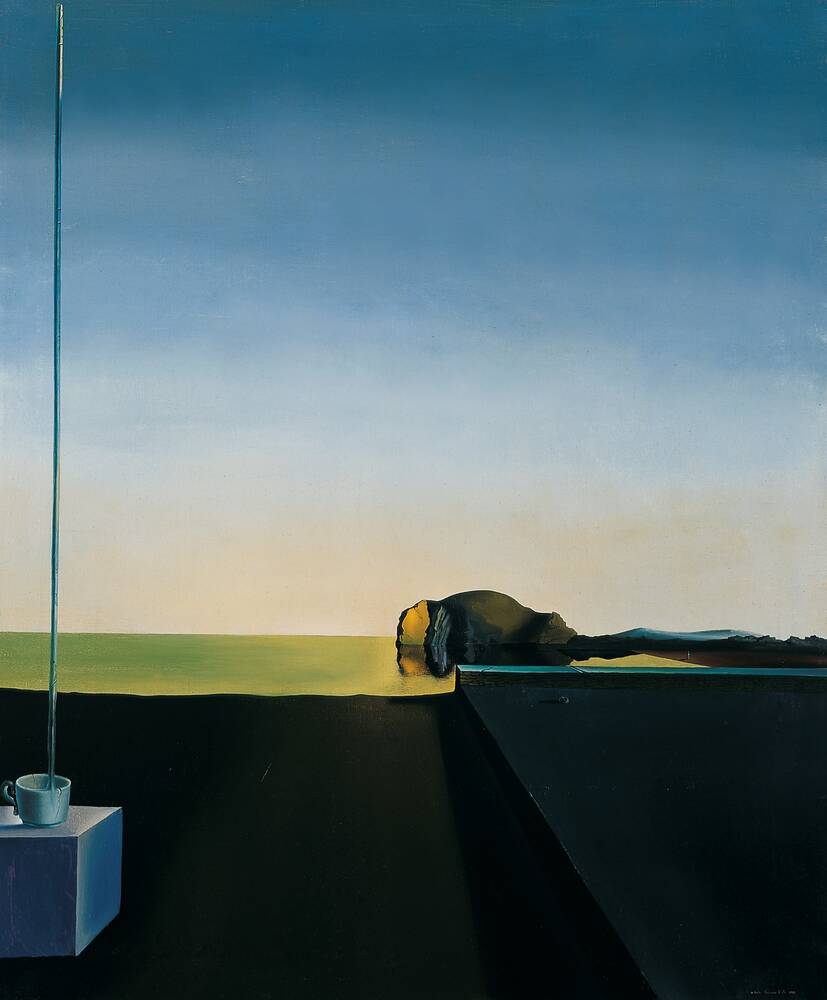
As in both models, the sky occupies much of the picture plane in Dalí's painting. At the low horizon, it meets a calm expanse of greenish water shimmering in the sunlight. A narrow headland with a high mountain ridge is reflected in the water. In the dark foreground on the left, a white cube catches the eye. On top of it stands a cup, from whose fragile rim a thin metal rod protrudes vertically upwards.
Dalí belonged to the circle of Parisian surrealists. He used his “paranoiac-critical method” to create his images. This method was intended to make the unconscious visible; according to Sigmund Freud, the unconscious reveals itself primarily in dreams. The emptiness and immobility of the scene, as well as details such as the small figure on the shore, create a mysterious tension. With this dreamlike landscape, Dalí attempts to not only reference Böcklin and Millet, but also exaggerate their suggestive effect.
- Location & Dating
- 1932
- Material & Technique
- Leinwand
- Dimensions
- 77,5 x 64,5 cm
- Museum
- Von der Heydt Museum
- Inventory number
- G 1049