


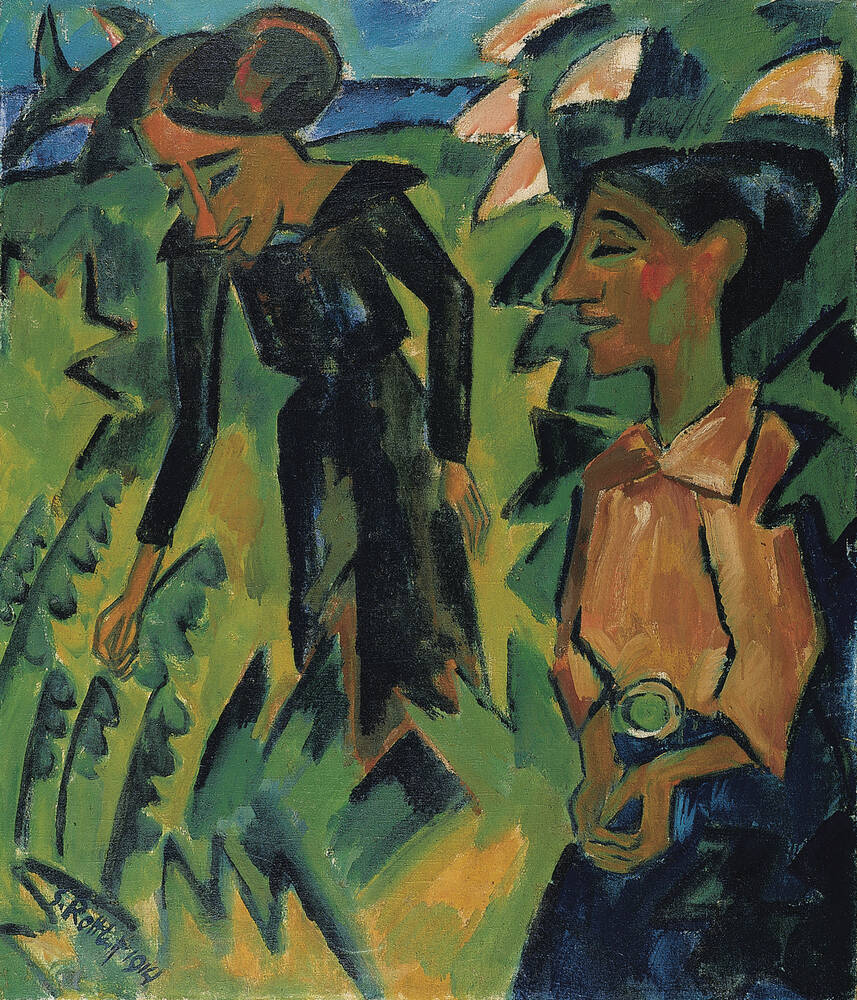
In December 1913, an exhibition of works by Picasso and African sculpture was held at the "Neue Galerie" in Berlin, which attracted considerable attention, particularly among the Expressionists. It can be assumed that Karl Schmidt-Rottluff also saw this exhibition. As a result, in 1914 he developed a new stereometric style of design that replaced the volume style based on curved lines. The painting "Two Women" shows the development of this new style for the artist: he simplified individual parts of the faces and reduced the pictorial elements to sharply contoured basic forms and areas of colour: The heads are now generally disproportionate and the noses take on a bridge-like, curved shape reminiscent of masks.
The painting belonged to the collection of the Erfurt shoe manufacturer and patron Alfred Hess, one of the most important private collections of modern art in Germany, since 1924 at the latest. After the collector's death in 1931, his son Hans Hess inherited the art collection. However, his mother Tekla Hess continued to look after the collection. When the National Socialists came to power on 30 January 1933, the Hess family was persecuted on racial grounds because of their Jewish origins. Hans Hess emigrated to France in 1933 and later to Great Britain. His mother followed him in March 1939. A large part of the art collection was transported to Switzerland in the summer of 1933. In the spring of 1937, Tekla Hess arranged for several works to be sent to the Cologne Art Association, including this painting. There, its trail was initially lost. In April 1947, Cologne art dealer Aloys Faust sold it to the Municipal Museum of Wuppertal, now the Von der Heydt Museum.
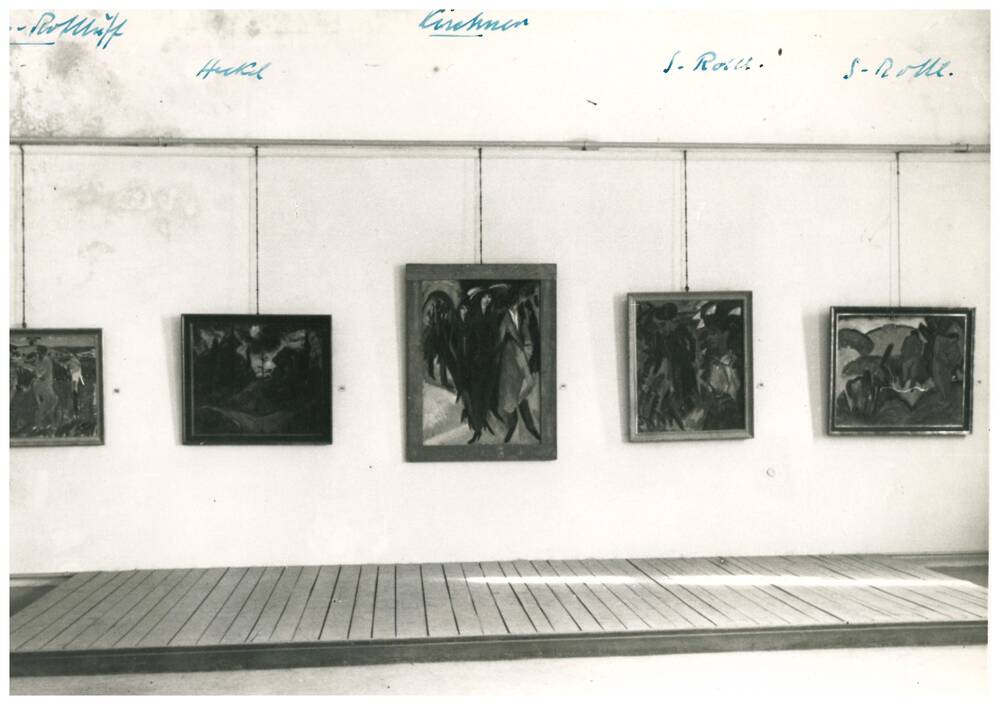
The purchase was of symbolic importance for the museum, as it was the first acquisition of an Expressionist painting after the end of the Second World War. It marked the beginning of efforts to compensate for the losses suffered during the Nazi era as a result of the ‘Degenerate Art’ confiscation campaign. Immediately after its purchase, it was exhibited in the ‘Exhibition of Expressionist Painting’.
Thanks to an amicable agreement with Hans Hess's heir, the painting can remain in the collection. It was restituted in 2025 and subsequently reacquired.
Further Media
- Location & Dating
- 1914
- Material & Technique
- Öl auf Leinwand
- Dimensions
- 101,5 x 87 cm
- Museum
- Von der Heydt Museum
- Inventory number
- G 0587