


The works of American artist Judith Rothschild (1921–1993) bridge the gap between European tradition and American Abstract Expressionism. Born into a German-Jewish family but raised in New York, Rothschild developed her own distinctive style within this cultural tension.
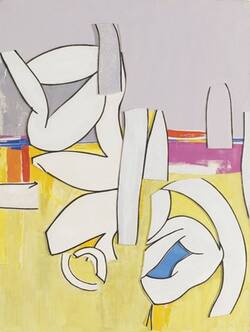
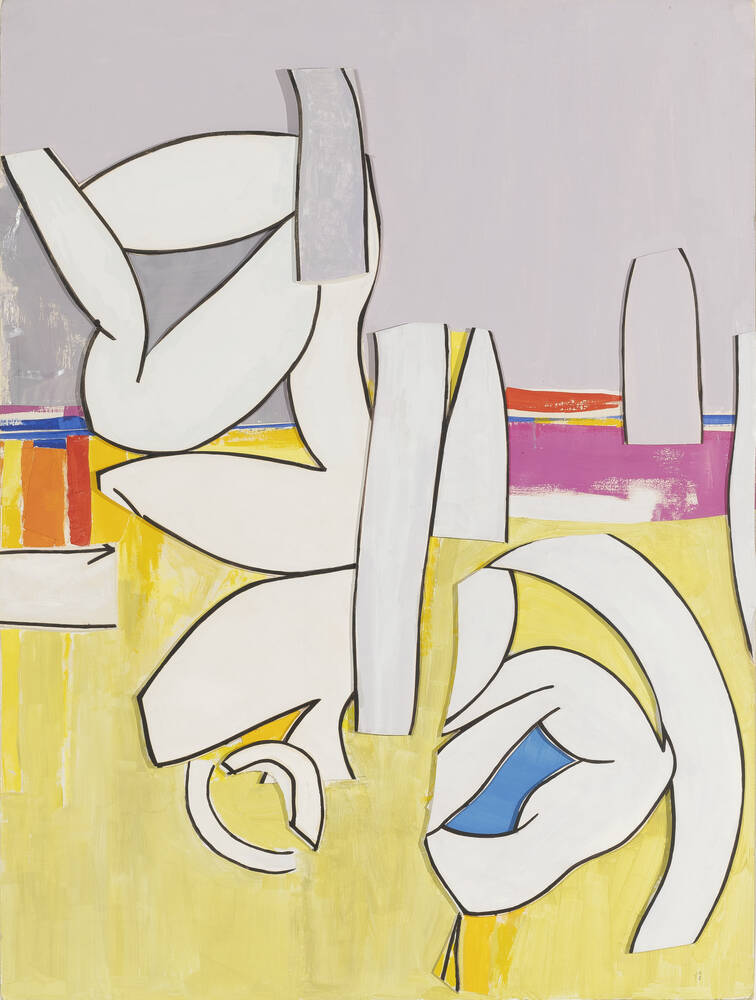
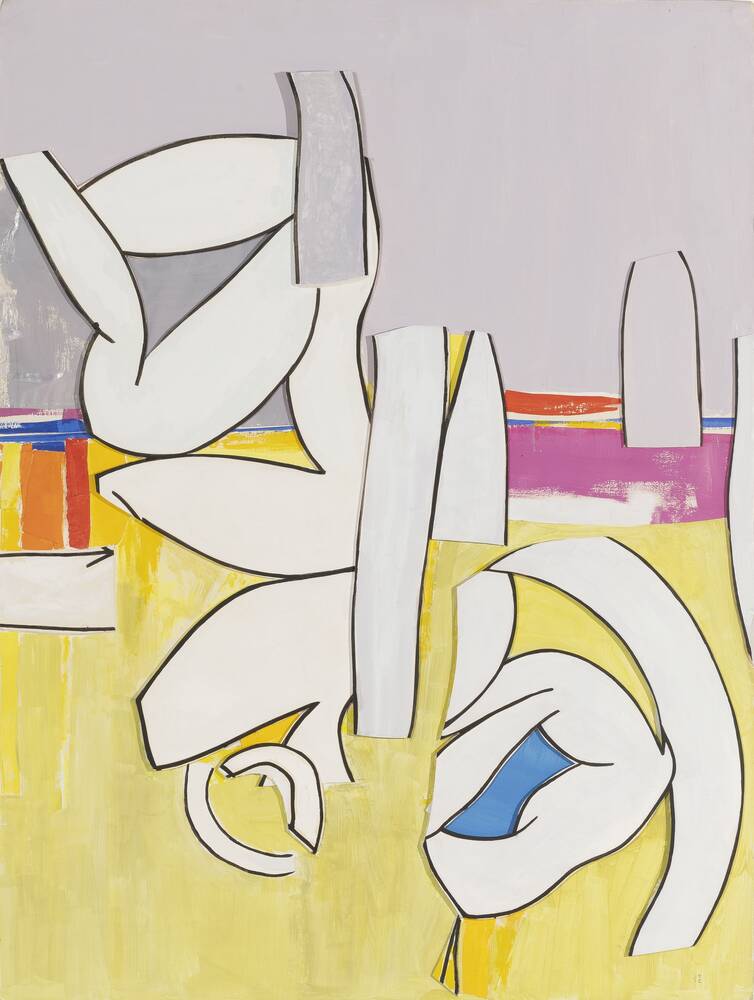
The 1972 painting “And Dancing on the Flat Shore” demonstrates her use of collage and a new technique of form-cutting. White, figurative, three-dimensional relief forms overlay a two-part picture plane with vibrant colors: pink at the top, fuchsia on the right, and yellow at the bottom. The color scheme and the title evoke the image of a seascape: above the yellow beach, the view opens up to the fuchsia sea beneath a pink sky. The horizon line is highlighted in blue.
With their black outlines, the white forms appear as figurative shapes. As relief forms, they create a sense of dance-like movement across the surface. The painting conveys emotions ranging from cheerfulness to melancholy, and the composition reflects a dynamic harmony. The painting may evoke memories of one’s own beach visits. Naturalism and abstraction are subtly balanced. The title “And on the level shore they dance” refers to a line from a poem by the Irish poet William Butler Yeats, which contributes to a poetic atmosphere.
In 1943 and 1944, Judith Rothschild studied in New York under Hans Hofmann, who played a key role as a bridge between the modern art traditions of Europe and America and as a pioneer of American Abstract Expressionism.
Further Media
- Location & Dating
- 1972
- Material & Technique
- Collage, Acryl und Tusche auf Schaumstoff
- Dimensions
- 101,9 x 76,5 cm
- Museum
- Von der Heydt Museum
- Inventory number
- G 1790