


Adolf Erbslöh was born in 1881 in New York City and grew up in Barmen. He initially began a commercial apprenticeship, following the family tradition, as he came from an industrialist family. At the age of 20, in 1901, he went to study art at the academy in Karlsruhe and continued his studies from 1904 in Munich. There, he also came into contact with a circle of artists who in 1909 founded the “Neue Künstlervereinigung München.” Founding members included, alongside Adolf Erbslöh, Gabriele Münter, Marianne von Werefkin, Alexej von Jawlensky, Wassily Kandinsky and Alexander Kanoldt.
At roughly the same time as the artist group Die Brücke, this association represented a second major direction of expressionist art in Germany striving toward abstraction. The first museum exhibition of the “Neue Künstlervereinigung München” took place in 1910 at the municipal Museum in Elberfeld. The second stop of the exhibition followed at the Ruhmeshalle in the Barmer Kunstverein.
The following year, Erbslöh left the Künstlervereinigung München and further developed his artistic style. His works increasingly followed the principles of Fauvism and Cubism. The painting “Haus im Garten” also dates from this phase. With his own variation of Cubism, he breaks down the forms of the mountainside, structures and restrains them using firm contour lines, and employs a color palette of graduated greens, turquoise, violet, and ochre tones. Only the villa enclosed by trees retains its three-dimensional appearance. In this way, he created an image of his personal experience of his Bergisches homeland, one that emphasizes not the gentle and inviting aspects but rather the sometimes threatening and dark character of this region.
The painting has been documented in the collection of August von der Heydt in Elberfeld since 1918. It was donated to the museum in 1952 by his son, Eduard von der Heydt.
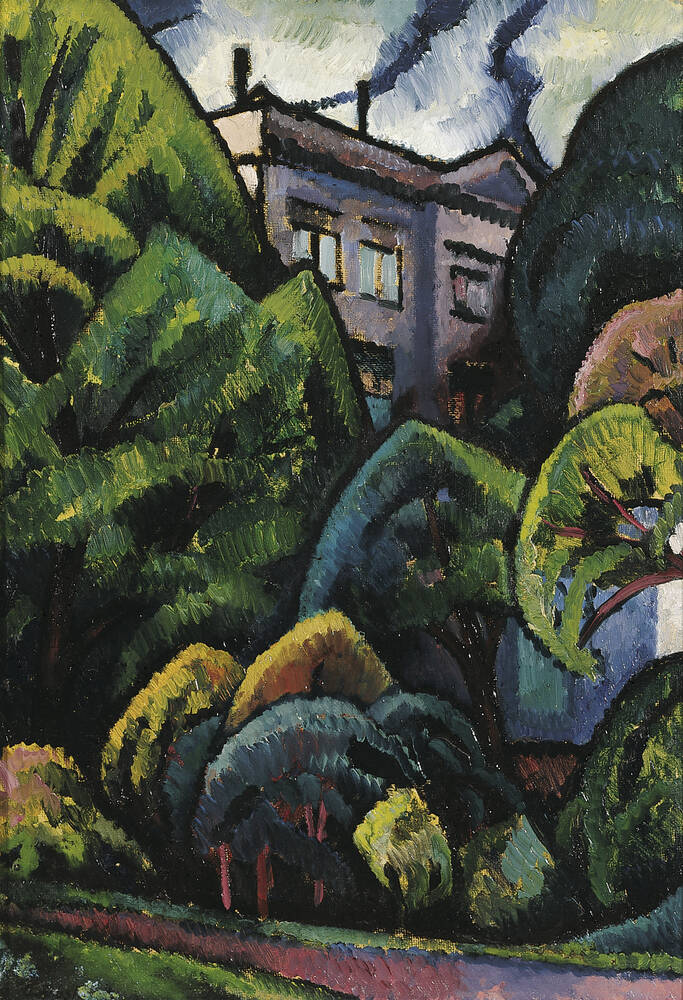
- Location & Dating
- 1912
- Material & Technique
- Öl auf Pappe
- Dimensions
- 72 x 50 cm
- Museum
- Von der Heydt Museum
- Inventory number
- G 0716