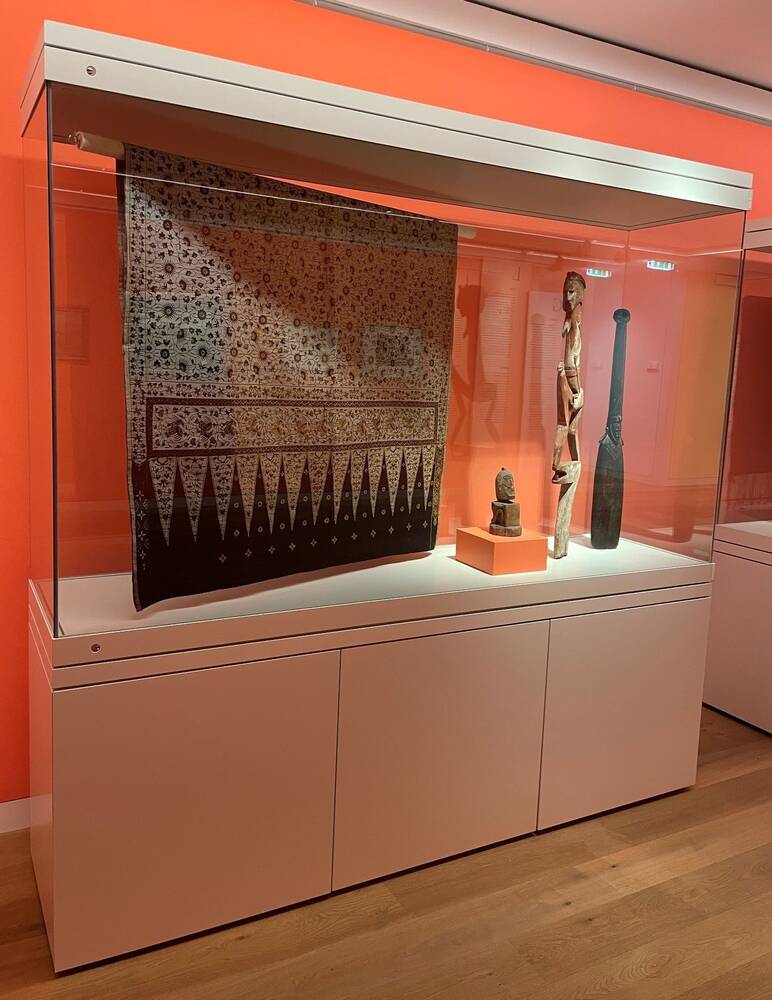


Another Indonesian textile from the former collection of Eduard von der Heydt is on display in this display case. It is a sarong that was made around 1900 on Java, possibly in Indramayu. This women’s wrap skirt is made of a densely woven, plain-weave cotton fabric. The dark blue pattern on a light blue background forms an all-over ornament created using the so-called batik tulis technique, a wax-resist method. The cloth derives particular value from the contours of the patterns, which are outlined with gold dust. By the way: This delicate ornament inspired the cover design for the catalog of the current exhibition “Beautiful & Strict. The Power of Ornament”. You can view the special exhibition on the second floor of the museum.
The three wooden objects come from the former colonies of German New Guinea (now Papua New Guinea) and the Solomon Islands, which were part of the German Empire and Great Britain in the past. These are ceremonial objects. A "Korwar" figure from Western New Guinea represents a recently deceased person and served as a supernatural receptacle for the spirit of the ancestor. These ancestor figures were depicted in a sitting or standing position with a prominent head and arrow-shaped nose. Korwars were kept and venerated in the home of the deceased, but were also taken on sea voyages or worn as amulets. These images of the ancestors played a central role in everyday life, protecting the living. The equestrian figure is probably a fragment of an ornamental decoration. The paddle, with a dark brown patina, has a carved mask-like head at the junction of the shaft and blade. It was probably used as a ceremonial object rather than as a paddle to propel a boat.